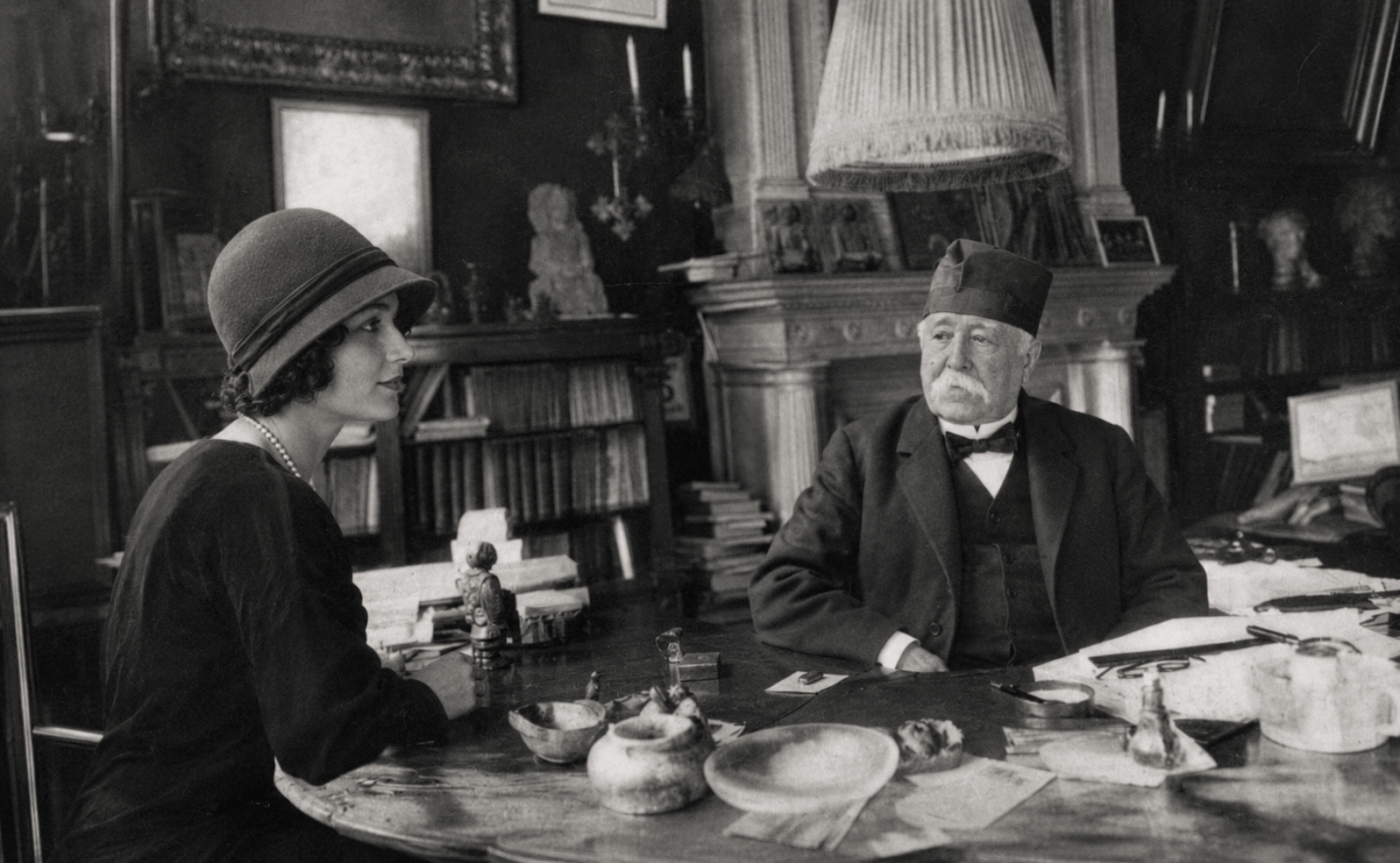
Since Pauline’s departure for New York is now inevitable, I refuse to let her cross the Atlantic without solid footholds! To open the doors of American academia to her and secure the goodwill of influential allies on the ground, one obvious course of action presents itself: calling upon the man who knows America better than anyone else in the Republic—my former patron, Georges Clemenceau. And so, this morning, I take her to 8, rue Benjamin-Franklin.
The old chief receives us in his study, wearing his skullcap, his gaze as piercing as ever beneath thick white eyebrows. After the customary greetings, he fixes Pauline with a mock-stern glare:
“So, mademoiselle, I hear you want to go running off to the New World to dissect corpses and count comets among the oil barons? Does France no longer produce enough stars to keep you here?”
Far from being intimidated by “Père la Victoire,” Pauline holds his gaze with a faint, wry smile:
“It produces admirable ones, Monsieur le Président, but our university mandarins clearly prefer to observe them from a great height… especially when they wear a skirt! And if your own memoirs are anything to go by, you hardly asked anyone’s permission when you set off for America at twenty-four.”
A suspended silence falls over the room. I hold my breath. Then, a hearty roar of laughter lifts the old man’s bushy moustache. He slaps the table with the palm of his hand:
“By God! Olivier, your daughter has even sharper claws than you! At last, someone who doesn’t bother with bowing and scraping.”
Delighted by this feisty spirit, Clemenceau immediately takes up his pen. Rather than settling for a formal letter of introduction to Franklin Roosevelt, he chooses to write directly to his wife, Eleanor Roosevelt, knowing full well how dedicated she is to women’s emancipation in New York.
In a few brisk, warm lines, he introduces Pauline as a compatriot who is “tenacious, fearless, and worthy of the highest regard.” Pauline leaves Rue Franklin with the prized open-sesame in her pocket and a triumphant smile.
As for me, I breathe a little easier.
The Historian’s Corner
1. 8, Rue Benjamin-Franklin: The Tiger’s Lair
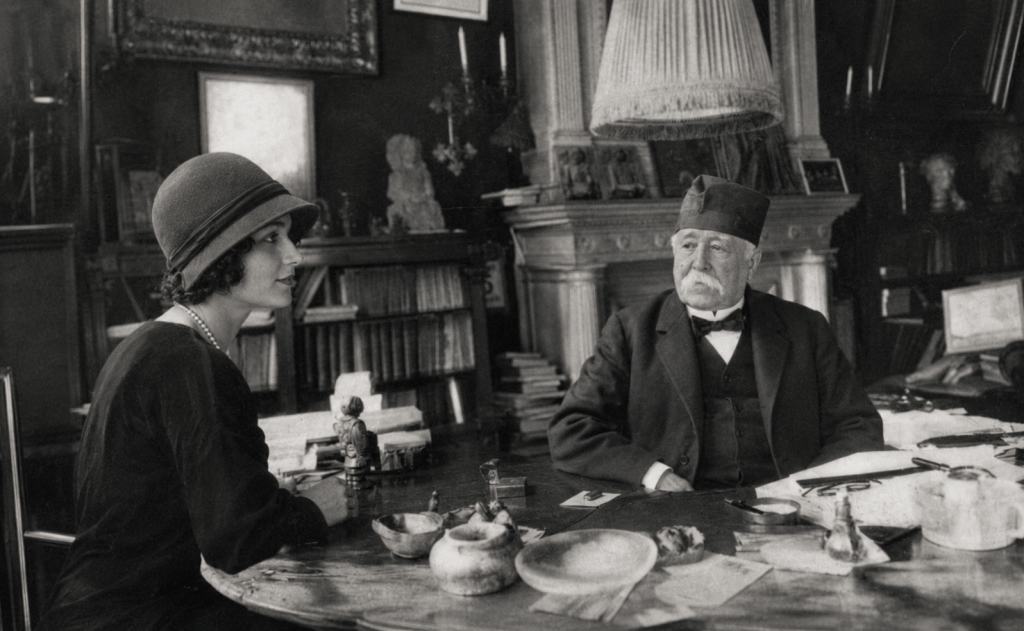
Having stepped back from active politics following his defeat in the 1920 presidential election, Georges Clemenceau divided his time between his modest home in Saint-Vincent-sur-Jard (Vendée) and his Parisian apartment at 8, rue Benjamin-Franklin (in the 16th arrondissement, now a museum).
In this ground-floor flat opening onto a private garden, the “Père la Victoire” received close friends, former collaborators, and prominent international figures amidst thousands of books and his Asian art collection. Despite being 84 years old in 1926, he maintained a relentless work schedule, wearing his iconic skullcap and silk fingerless gloves to protect his skin, which had been sensitized by eczema.
2. Clemenceau the Physician: A Scientific Youth
Before becoming a journalist and statesman, Clemenceau was first a medical doctor. He defended his doctoral thesis in Paris in May 1865 (De la génération des éléments anatomiques / On the Generation of Anatomical Elements), deeply influenced by the positivism and scientific materialism of Auguste Comte and Charles Robin.
Although he practiced only briefly in the Montmartre district, he retained a lifelong fondness for medical practitioners and an enduring fascination with the natural and medical sciences.
3. The Formative Exile in the United States (1865–1869)
Freshly graduated and seeking to escape the authoritarian regime of Napoleon III, the 24-year-old Clemenceau sailed for the United States. He spent nearly four decisive years there:
- Journalist: He served as a regular correspondent for the Parisian newspaper Le Temps, covering post-Civil War Reconstruction and offering incisive analyses of nascent American democratic institutions.
- Teacher: He taught French and horseback riding at the Catharine Aiken School, a young women’s academy in Stamford, Connecticut.
- Personal Life: There he met one of his students, Mary Plummer, whom he married in 1869 before returning to France.
This immersive stay allowed him to achieve fluent English and cultivate an extensive network of transatlantic friendships that lasted throughout his lifetime.
4. Why Eleanor Roosevelt in 1926?
Choosing to address a letter of recommendation to Eleanor Roosevelt rather than her husband Franklin was especially shrewd in 1926:
- FDR’s relative withdrawal: After contracting polio in 1921, Franklin D. Roosevelt spent much of 1926 undergoing rehabilitation in Warm Springs, Georgia. He had not yet been elected Governor of New York (an office he would assume in 1928).
- A woman of influence in Manhattan: During this period, Eleanor Roosevelt became the true political and civic driving force of the family in New York. A tireless activist, she was deeply involved with the Women’s Trade Union League (WTUL) and the League of Women Voters, and was preparing to buy a stake in the Todhunter School for girls, where she also taught.
- A supportive female network: Passionately committed to women’s intellectual and professional emancipation, Eleanor Roosevelt was the ideal ally to help guide a young Frenchwoman navigating the American metropolis.
5. The Clemenceau–Roosevelt Connection
Clemenceau shared a mutual admiration with the Roosevelt family, particularly with former Republican President Theodore Roosevelt (Eleanor’s uncle), whom he had met during his travels and with whom he shared a pugnacious temperament and legendary outspokenness.
During his final, triumphant speaking tour across the United States in late 1922, Clemenceau had rekindled his political and social contacts along the East Coast—making his intercession with the Roosevelt circle both entirely natural and highly effective.


Laisser un commentaire