
Born on September 10, 1868, in Paris, Olivier is of Auvergne and Breton descent, the son of schoolteachers. He grew up in the 9th and 10th arrondissements, living in the modest, top-floor apartments of buildings lacking modern comforts.
An exceptional student and a true product of Republican meritocracy, he attended the Lycée Condorcet. He read everything he could lay his hands on and developed a deep passion for history. During his school years, he took two quiet but endearing young classmates under his wing: Paul Valéry and Marcel Proust…
…before entering the École normale supérieure on Rue d’Ulm. There, he became close with the librarian, Lucien Herr…
…who introduced him to two other students at the institution, slightly younger than Olivier, who would become his lifelong friends: Léon Blum and Charles Péguy.
Olivier also attended classes at the École libre des sciences politiques on Rue Saint-Guillaume and passed the competitive entrance exam for the Conseil d’État (Council of State), where he discovered the inner workings of the Republic’s administration.
At the age of 26, our friend was seconded to the Ministry of the Interior by Célestin Hennion—a legendary figure and brilliant policeman tasked, among other duties, with protecting heads of state.
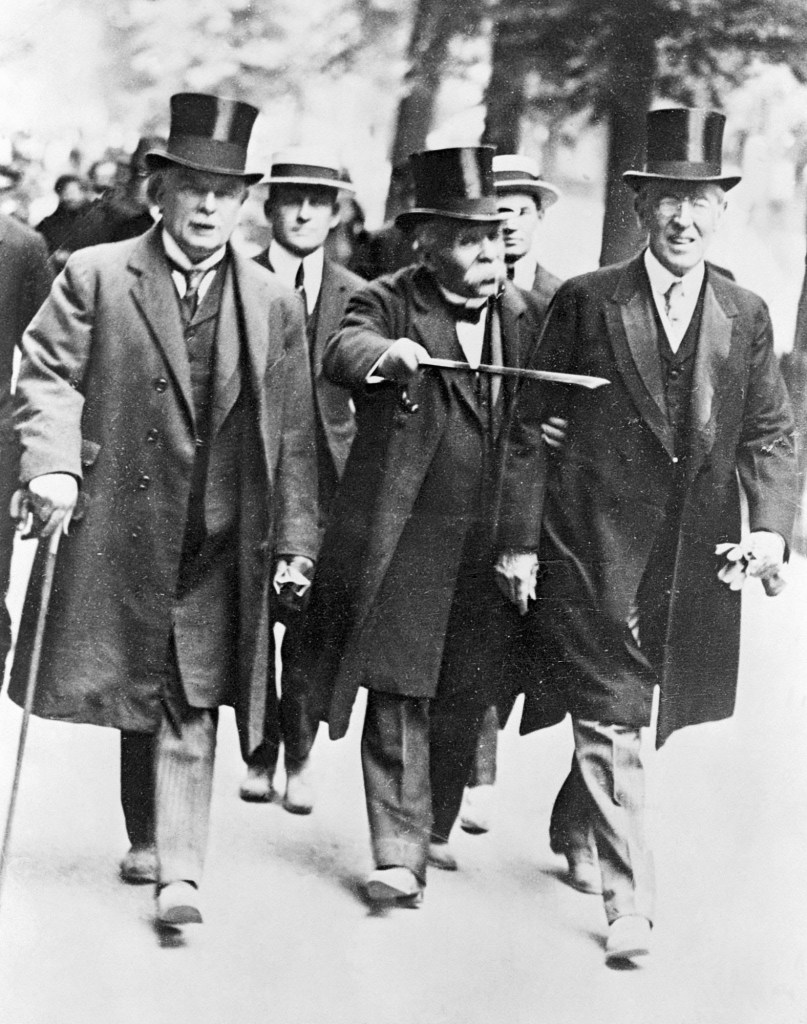
Olivier quickly stood out for his ingenuity and his talents as a negotiator.
In March 1906, he was called by Director Étienne Winter to join the cabinet of Georges Clemenceau, then Minister of the Interior. When Clemenceau became Prime Minister (Président du Conseil) in October 1906, Olivier remained by his side.
Highly esteemed by Georges Clemenceau (known as « The Tiger, Le Tigre « ), who made him one of his closest, most trusted aides, our hero was affectionately dubbed « Olivier le Tigre » by his colleagues.
During three intense years, he was entrusted with a wide range of sensitive missions, both within France (negotiating during bitter labor strikes and social conflicts, gathering intelligence on prominent figures, and coordinating police forces during complex criminal investigations) and abroad (travelling to Berlin, Constantinople, Prague, and Vienna).
In Prague, Olivier le Tigre struck up a friendship with a certain Franz Kafka. In Vienna, he mingled with Klimt, visited Dr. Freud, and socialized with Sonia Knips. In short, Olivier le Tigre certainly knew how to combine business with pleasure.
Following the fall of the Clemenceau government in July 1909, Olivier le Tigre had to step down. He offered his writing talents to Adrien Hébrard, director of the prestigious evening newspaper Le Temps.
Ultimately, after much hesitation, the new Prime Minister, Aristide Briand, decided to bring Olivier le Tigre back into his cabinet to handle the most delicate and thorny issues.
Successive Prime Ministers (such as Ernest Monis and Joseph Caillaux) would keep our hero by their sides, all deeply attached to his recognized expertise in diplomacy and internal affairs.
On April 27, 1914, President of the Republic Raymond Poincaré asked Olivier le Tigre to join his staff at the Élysée Palace. He asked him to maintain a close liaison with the Prime Minister, keep tabs on General Joffre (the Chief of the General Staff), assist the Head of State with diplomatic matters, monitor domestic affairs, cultivate relationships with left-wing political figures, writers, and artists, and report back on the gossip circulating in high-society salons and dinner parties—not to mention undertaking occasional confidential missions to foreign capitals…
In his spare time (sic), just before the outbreak of the war, Olivier lectured at the École de Guerre, where he engaged in relentless, passionate debates over military strategy with the school’s director, General Foch.
Olivier le Tigre is married and the father of three children:
His eldest son, Nicolas, was drafted in early May 1915 to train as a reconnaissance pilot on a Farman F20 aircraft. Following the Armistice, Nicolas crossed paths with a certain Pierre-Georges Latécoère, with whom he shared grand ambitions.
After November 11, 1918, Olivier and his family settled in Versailles.
Our hero continues his work alongside both the Head of State and the Prime Minister, while remaining a familiar face among the artistic and journalistic elite of Tout-Paris.

