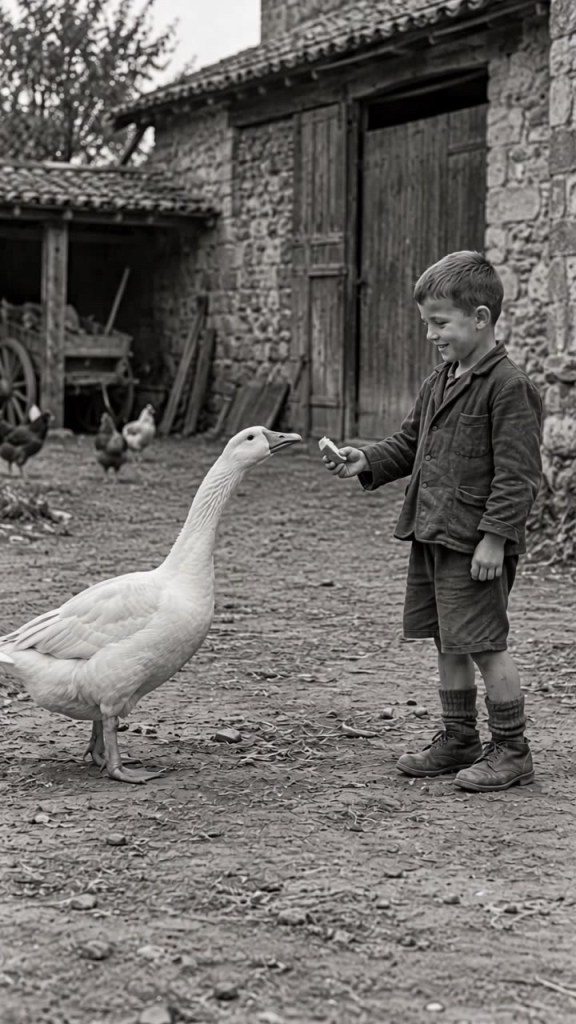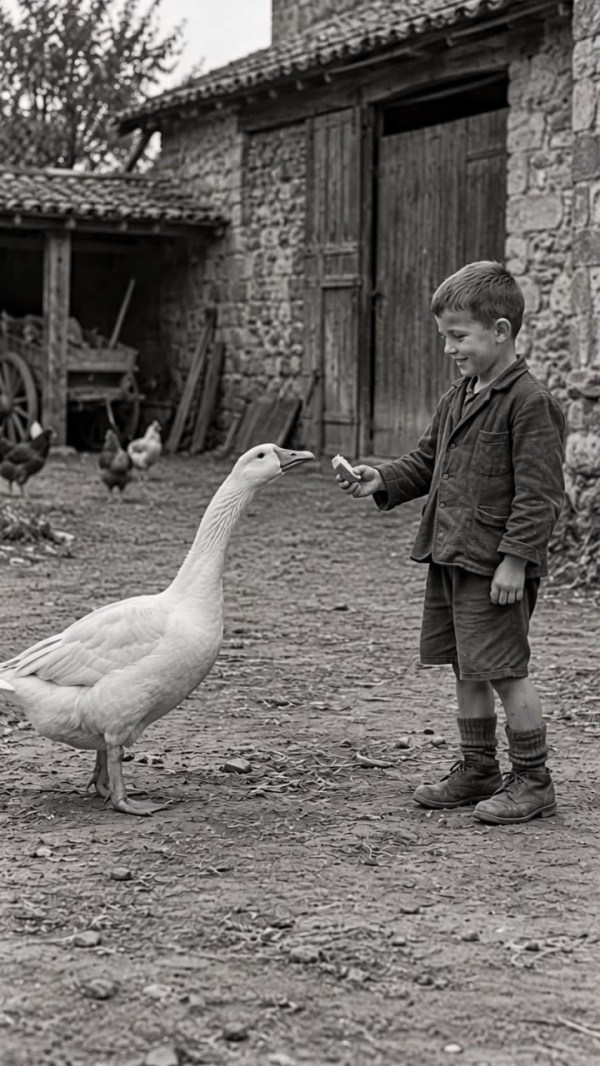
Séjour à Chiroubles. Je traverse une ferme où un gamin de huit, neuf ans, essaie de donner un morceau de pain à une oie dodue aussi rapide qu’agressive. Il tend plusieurs fois la main et, à chaque tentative, l’animal projette, d’un mouvement fulgurant, son cou puissant, sa tête dure aux yeux sans pitié et manque de mordre le pauvre enfant qui recule, malheureusement légèrement plus lentement, avec effroi.
Le gosse ne se décourage pourtant pas. Il s’efforce, avec application, de mettre la nourriture pile dans le bec de l’animal, sans avoir la main en sang en retour. La bête, de son côté, ne comprend guère le petit jeu et augmente la rapidité et l’audace de ses assauts afin d’arracher ce qui lui semble dû.
J’observe la scène, au départ avec amusement, puis avec un réel intérêt.
Au-delà de savoir qui va gagner entre le petit d’homme et le volatile teigneux, il me semble que j’assiste à une jolie leçon de vie. Le marmot est en plein apprentissage hors école. Il découvre la patience, le courage voire la témérité et s’oblige – faute d’être le plus fort – à anticiper et agir avec plus d’intelligence que son adversaire, au risque, en cas d’échec, d’être cruellement mordu.
Les rencontres diplomatiques que j’ai pu vivre comme les négociations de crise au ministère de l’Intérieur, avec des interlocuteurs puissants et parfois très retors, avaient de nombreux points communs avec ce « jeu de l’oie » improvisé et grandeur nature.
Le pain finit par atterrir, avec souplesse et adresse, dans la gueule de la bestiole et le garçonnet n’est pas blessé. Il me jette un discret regard satisfait mais recherchant aussi, manifestement, l’approbation. Je le félicite alors d’un bruyant : « Bravo, p’tit gars ! » .
Je n’ose me lancer dans une leçon de choses avec lui à partir de cette expérience toute fraîche. Il vaut mieux le laisser jouer tranquille et même si ce n’est pas l’envie qui me manque d’enseigner comme un vieux sage, je me ravise : Après tout, je ne suis pas son instituteur.
« Une petite question mon garçon : Quel est ton prénom ? »
Je n’ai pu m’empêcher cette ultime curiosité.
– Georges, m’sieur !” me lance-t-il, avec une voix étonnamment forte et assurée.
À mon tour de lui faire part de ma surprise amusée :
– Tiens ? Comme Clemenceau !
l’enfant malin et audacieux face à l’oie affamée.
Le coin de l’historien — L’école et la basse-cour dans la France de 1926
Dans la France rurale des années 1920, les enfants grandissent au contact quotidien des animaux domestiques. La basse-cour est un espace de travail, mais aussi de découverte. On y apprend à nourrir les volailles, à ramasser les œufs, à reconnaître les comportements des animaux et à s’en méfier lorsque cela devient nécessaire.
Les oies occupent une place particulière dans l’économie paysanne. Elles fournissent de la viande, de la graisse, des plumes et du duvet. Leur élevage représente notamment une ressource importante dans certaines régions du Sud-Ouest. Leur tempérament territorial et leurs réactions parfois brusques en font aussi des animaux dont les enfants doivent apprendre à se garder.
Depuis la loi du 28 mars 1882, l’instruction est obligatoire pour les garçons et les filles de six à treize ans. Mais cette obligation n’efface pas les traditions rurales. Les enfants continuent de participer, selon leur âge et les besoins de leur famille, aux activités agricoles et domestiques. Les travaux saisonniers restent d’ailleurs une cause d’absentéisme scolaire, que les pouvoirs publics cherchent à combattre.
L’école républicaine elle-même ne se limite pas aux livres. Les programmes prévoient des notions de sciences naturelles, des applications à l’agriculture, des travaux manuels et l’apprentissage de l’usage des outils. L’instruction doit préparer les enfants à comprendre le monde dans lequel ils vivent.
La scène du petit Georges et de son oie illustre ainsi une réalité familière aux campagnes de l’entre-deux-guerres : une partie de l’éducation se fait par l’expérience, au contact des animaux, des outils et des risques ordinaires de la vie rurale. Ce savoir pratique ne remplace pas l’école ; il la complète.