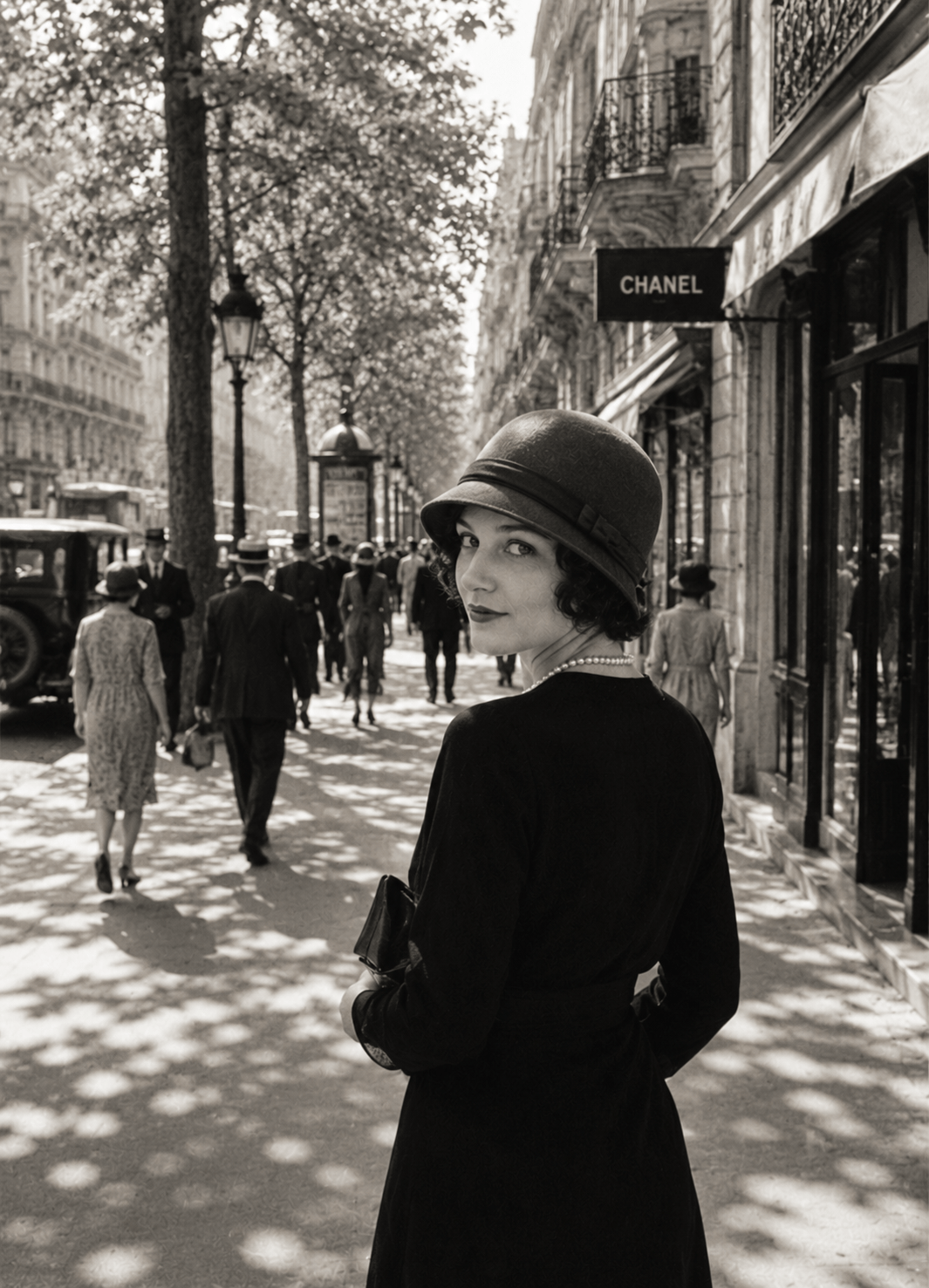
Forget the frills, discard the corsets, and chop off your hair! At the dawn of the 1920s, Paris wasn’t just recovering from the Great War—it was reinventing the world. In the capital of the Roaring Twenties (Les Années Folles), fashion was no longer a mere matter of vanity or social status. It became a political manifesto, an aesthetic shockwave, and the reflection of an absolute urgency to live.
From the terrace of the Café de la Paix to the salons of Rue Cambon, silhouettes became lighter, faster, and freer. Welcome to the decade when women took control of their own bodies.
1. The Silhouette Revolution: The Rise of the « Garçonne »
The great trauma of 1914–1918 paradoxically opened the doors to emancipation. Having replaced men in factories, offices, and fields, women refused to return to the fabric prisons of the Belle Époque. The « S-curve » silhouette previously imposed by the corset collapsed.
A Geometry of Freedom
The decade imposed a radically new line:
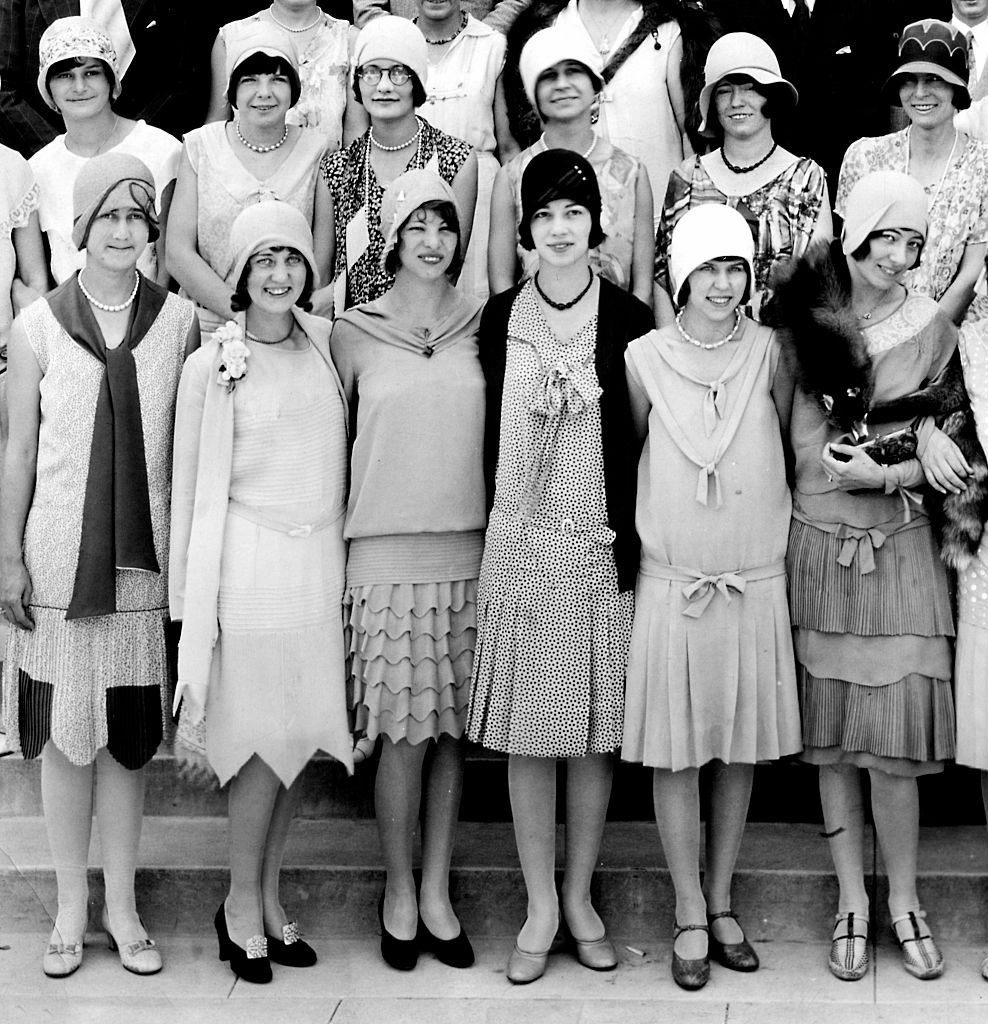
- The tubular line: The bust was flattened by bandeau bras, the waist dropped to the hips, and the silhouette became rectangular, almost androgynous.
- Shorter hemlines: For the first time in Western fashion history, legs were revealed. By 1926, skirts reached the knee—the absolute peak of the decade.
- The « garçonne » (flapper) cut: Popularized by Victor Margueritte’s eponymous 1922 novel, short hair (the Irene Castle bob or the Josephine Baker crop) became the ultimate symbol of modernity.
- The cloche hat: Pulled right down to the eyes, it forced women to tilt their heads back, giving Parisian women that signature purposeful stride, eyes fixed on the future.
Did you know? This fashion was primarily functional. It was all about being able to jump onto a tramway, drive an automobile, raise your arms at the office, and dance the Charleston or the Black Bottom until dawn without suffocating.
2. The Masters of Style: When Haute Couture Revolutionized Itself
Paris confirmed its status as the fashion capital of the world, but the rules of the game had changed. Pre-war opulence faltered in the face of modern efficiency.
Gabrielle “Coco” Chanel: The Democratization of Elegance
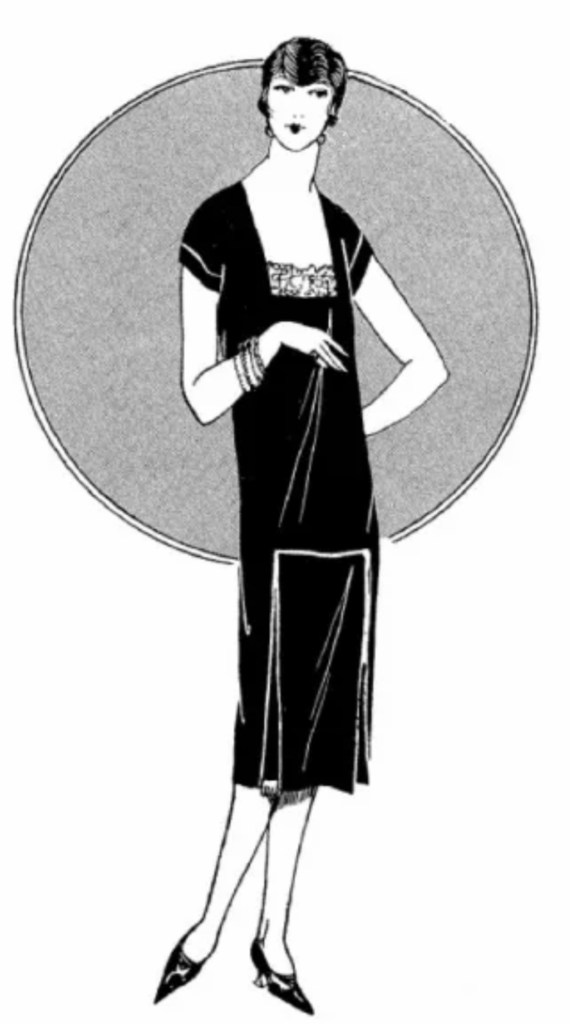
Chanel understood before anyone else that modern women needed comfort. She snatched jersey from men’s underwear to create fluid ensembles. In October 1926, she published a drawing of a biblically simple black dress in the American edition of Vogue. The magazine dubbed it Chanel’s « Ford » dress, a nod to Henry Ford’s Model T car: simple, black, accessible, and ordered by the millions. The Little Black Dress (LBD) was born.
Paul Poiret: The Fallen King of the Orient
The great Paul Poiret, who had nevertheless freed women from pre-war petticoats, missed the turning point of the 1920s. He remained attached to oriental drapes, heavy brocades, and theatrical pomp. At the 1925 International Exhibition of Decorative Arts, his three sumptuous barges (Amours, Délices, and Orgues) ruined him. Women no longer wanted to be static works of art; they wanted speed.
Sonia Delaunay: Art in Motion
In stark contrast to Poiret, Sonia Delaunay applied the theories of Cubism and Simultaneism directly to fabric. Her Boutique Simultanée at the 1925 Exhibition caused a sensation. Her dresses featured diamonds, broken lines, and vivid color contrasts. Fashion became a living graphic art.
Jean Patou: The Inventor of Sportswear
The other genius of the decade seized upon the importance of physical culture and the great outdoors. By dressing tennis champion Suzanne Lenglen in a sleeveless, knee-length pleated white silk skirt, Patou invented modern sportswear and popularized the sun-kissed tan.
3. A Social and Technical Revolution
1920s fashion is inseparable from the technological mutations and shifting morals of its time.
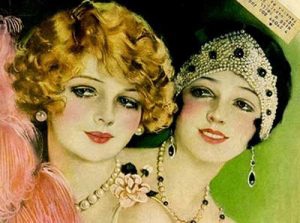
- Public makeup: Pulling out a compact mirror and a tube of lipstick (invented in its modern form in 1915) in the middle of a crowd or at a café was no longer the preserve of courtesans. It was a sign of raw, unapologetic bourgeois confidence.
- Invisible undergarments: Exit the multiple petticoats. Enter the lightweight girdle and bandeau bra.
- The triumph of tanning: Influenced by Josephine Baker and the summer holidays launched on the French Riviera by the « Riviera Set, » porcelain skin—once a sign of nobility—became outdated. A tan became the symbol of a healthy, athletic, and free life.
- The press and paper patterns: Thanks to magazines like Vogue Paris (launched in 1920) or Le Petit Écho de la Mode, shopgirls, typists, and bourgeois women instantly shared the same visual codes. A handy typist could copy a designer dress for thirty francs’ worth of fabric.
4. Sources and References for Further Reading
For students, researchers, or costume history enthusiasts, here are the essential, scientifically validated documentary resources:
Institutions and Museums (France & International)
- Palais Galliera – Musée de la Mode de la Ville de Paris: Houses one of the world’s most important collections of 1920s clothing. Their exhibition catalogues (particularly on the Roaring Twenties and Gabrielle Chanel) are authoritative references.
- The Metropolitan Museum of Art (The Met – Costume Institute, New York): Offers an exceptional online database featuring digitized period pieces from Chanel, Patou, and Poiret.
- Musée des Arts Décoratifs (MAD Paris): Essential for studying the connection between 1920s fashion and the 1925 Art Deco movement.
Digital Archives and Periodicals
- Gallica (Bibliothèque nationale de France): Provides free online access to period issues of Vogue Paris (from 1920 onward), the Gazette du Bon Ton, and the Journal des Dames et des Modes.
- L’Illustration: The major weekly magazine of the era, a goldmine for analyzing fashion advertisements, perfume launches (such as Chanel No. 5 in 1921), and the sociological evolution of silhouettes.
Historical Reference Books
- Valerie Steele, Paris Fashion: A Cultural History, Bloomsbury Academic. (The definitive work by the famous American fashion historian and director of the MFIT).
- Marylène Delbourg-Delphis, Le Chic et le Look: Histoire de la mode féminine et des mœurs de 1850 à nos jours, Éditions Hachette. (A sharp sociological analysis of the Roaring Twenties).
- Exhibition Catalogue, « 1925, quand l’Art Deco séduit le monde », Cité de l’architecture et du patrimoine / Éditions Norma.

