For anyone joining our story mid-stride, let me summarize the tempest: my twenty-one-year-old daughter, Pauline, has decided to slam the door on the French medical establishment to conquer New York, its universities, and its astronomical observatories. My old boss, Georges Clemenceau, thoroughly won over by the young lady’s audacity, has already provided her with a choice passport to high society: a personal letter addressed to Eleanor Roosevelt. As for me, having just been tasked by Raymond Poincaré with quietly negotiating behind the scenes with Margaret L. Hayes—a brilliant diplomat at the American Embassy and the granddaughter of a former president—to steady the franc on Wall Street, I was left with the task of turning this headstrong whim into a flawlessly orchestrated landing.
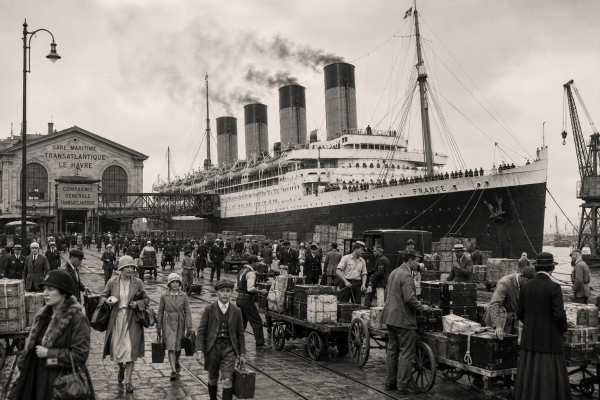
This morning, Pauline’s bedroom looks like an expeditionary army’s staging camp. In the center of the room sit two bulky, domed trunks of coated canvas, fortified—mercifully—with brass fittings. No milliner’s frivolities here: my daughter is outfitting her voyage like a merchant marine officer. I watch her systematically stack Testut’s hefty Treatise of Human Anatomy, her star-gazing logbooks crammed with equations, her stethoscope, and a small refracting telescope swaddled in three layers of woolen sweaters.
“Not a single evening gown for New York?” I ask, bemused, lifting a bundle of white lab coats.
“You don’t observe the Andromeda Nebula in a crinoline, Father,” she shoots back without looking up. “And at Columbia, I doubt the microscopes care much for lace.”
At two in the afternoon, I leave this cheerful chaos to meet Margaret L. Hayes in the hushed lounge of a grand hotel on the Place de la Concorde. The Second Secretary welcomes me with her leather-bound notebook and a black coffee. I swiftly cover the essentials on the political front: Poincaré’s ironclad resolve, the impending creation of the autonomous sinking fund to secure Treasury bonds, and the opening of our backchannel to reassure Washington.
Margaret jots down a few quick notes, gives an approving nod, and snaps her notebook shut:
“Splendid. The markets will welcome Monsieur Poincaré’s firmness. But if I read between the lines correctly, Olivier, you didn’t request this meeting merely to hold forth on war debts.”
“Indeed. Now that the franc is well on its way to recovery, let us settle a far more delicate matter: my daughter arrives on your shores at the end of the month.”
For a fraction of a second, Miss Hayes’s mask of diplomatic composure cracks, giving way to a knowing smile. She draws two typewritten official documents from a folder:
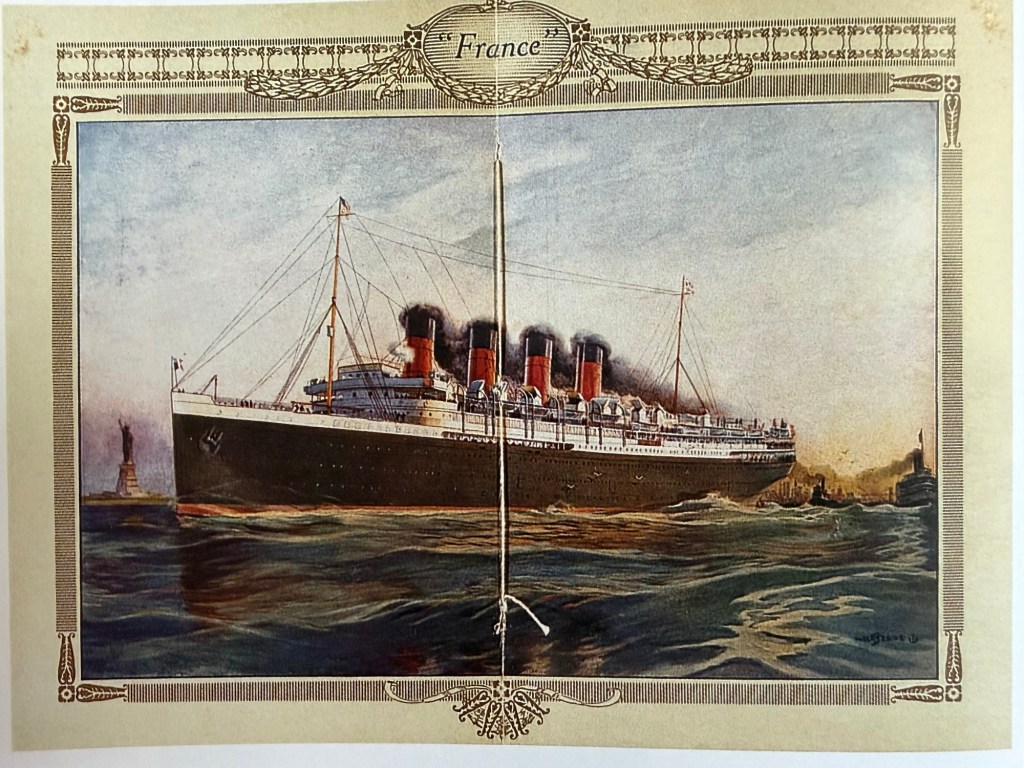
“I anticipated your request. Pauline will travel second class aboard the French Line’s ocean liner Paris. That will spare her the ordeal of Ellis Island: customs clearance will be conducted directly on board before docking at the Manhattan pier. As for accommodation, I have secured her a room at International House on Riverside Drive, just steps from the Columbia campus. It is modern, well-supervised, and cosmopolitan. And finally, here is her consular letter of introduction.”
I gaze at the papers stamped with the American eagle. Between the handwritten note from “The Tiger” to Mrs. Roosevelt and the embassy’s backing, Pauline is about to cross the Atlantic flanked by an invisible yet formidable escort.
“Well, Miss Hayes… you certainly don’t do things by halves.”
Margaret straightens her tailored jacket, her eyes twinkling:
“Rest assured, Olivier: with patrons like these, your daughter won’t merely set foot in New York… she is going to take full possession of it.”
The Historian’s Corner: America and France in the Summer of 1926
The Art of Trunks and Transatlantic Logistics: Packing for a six-day ocean crossing was an exacting science, strictly regulated by shipping lines:
- The Cabin Trunk (steamer trunk): Bearing the regulatory “Wanted on voyage” label, it was restricted in height (roughly 14 inches) to slide beneath the berth, or took the form of a vertical wardrobe trunk fitted with hangers and lockable drawers. It contained undergarments, daytime attire, toiletries, and reading material needed for life on board.
- The Hold Trunk (“Not wanted on voyage”): Substantially heavier and more voluminous, reinforced with beechwood slats and brass corner brackets, it held surplus clothing, linens, instruments, and heavy volumes like the Testut treatise. Once loaded into the hold, it remained entirely inaccessible until disembarkation.
- Protection from Sea Air: The North Atlantic’s salty dampness and condensation in the cargo holds required rigorous precautions: watertight trunks lined with zinc or vulcanized fiber, sheets of tissue paper placed between fabrics to preserve delicate textiles, and camphor balls to protect wool and leather bindings from mildew.
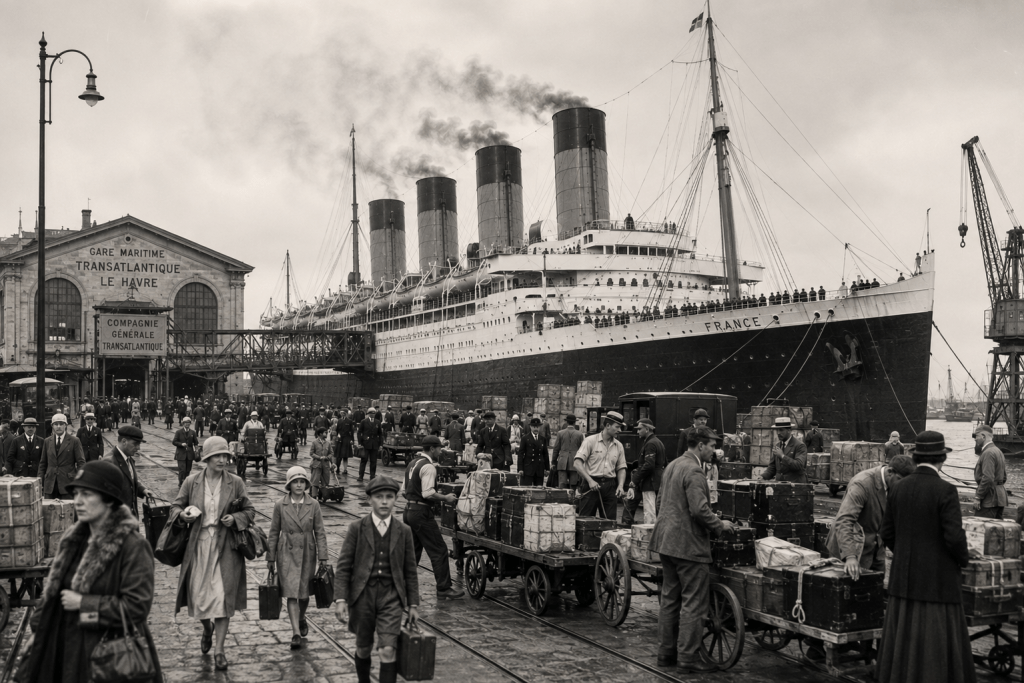
- Rail Transit: In Paris, travelers checked their baggage at the Gare Saint-Lazare using color-coded tags from the Compagnie Générale Transatlantique (indicating the vessel, class, and stateroom number). Trunks were transported via dedicated baggage vans directly to the Le Havre departure pier and hoisted aboard by dockside cranes.
Bypassing Ellis Island for Cabin Passengers: In the 1920s, first- and second-class passengers were spared the ordeal of the Ellis Island immigration depot. Administrative processing, visa inspections, and routine health checks were conducted directly on board by American officials before the ship docked at the Hudson River piers in Manhattan. Only steerage (third-class) passengers were transferred by ferry to the island for comprehensive medical examinations and rigorous questioning.
New York’s International House: Opened in September 1924 at 500 Riverside Drive, across from Riverside Church and right next to Columbia University, this grand student residence was established through the philanthropy of John D. Rockefeller Jr. and the Dodge family. Designed to foster intellectual exchange among students from across the globe, it provided foreign scholars with a modern, secure, and cosmopolitan environment.
Léo Testut’s Treatise of Human Anatomy: A monumental four-volume work lavishly illustrated by Gaston Devy (and later revised with André Latarjet), the “Testut” formed the undisputed cornerstone of French medical education. For a student like Pauline, taking her own set to New York was both a heavy physical undertaking and a badge of pride, representing the rigorous standard of the Parisian clinical method.
Poincaré’s Financial Plan and the Autonomous Sinking Fund: Confronted with an acute currency crisis in July 1926, Raymond Poincaré assumed both the Premiership and the Finance portfolio. To halt speculation against the franc without bowing to the aggressive demands of Anglo-American creditors, he secured parliamentary approval for 11 billion francs in new taxes and established the Autonomous Fund for the Management of National Defense Bonds (Caisse autonome de gestion des bons de la Défense nationale), which was permanently enshrined in the French Constitution by the Parliament convened in Congress at Versailles on August 10, 1926.

