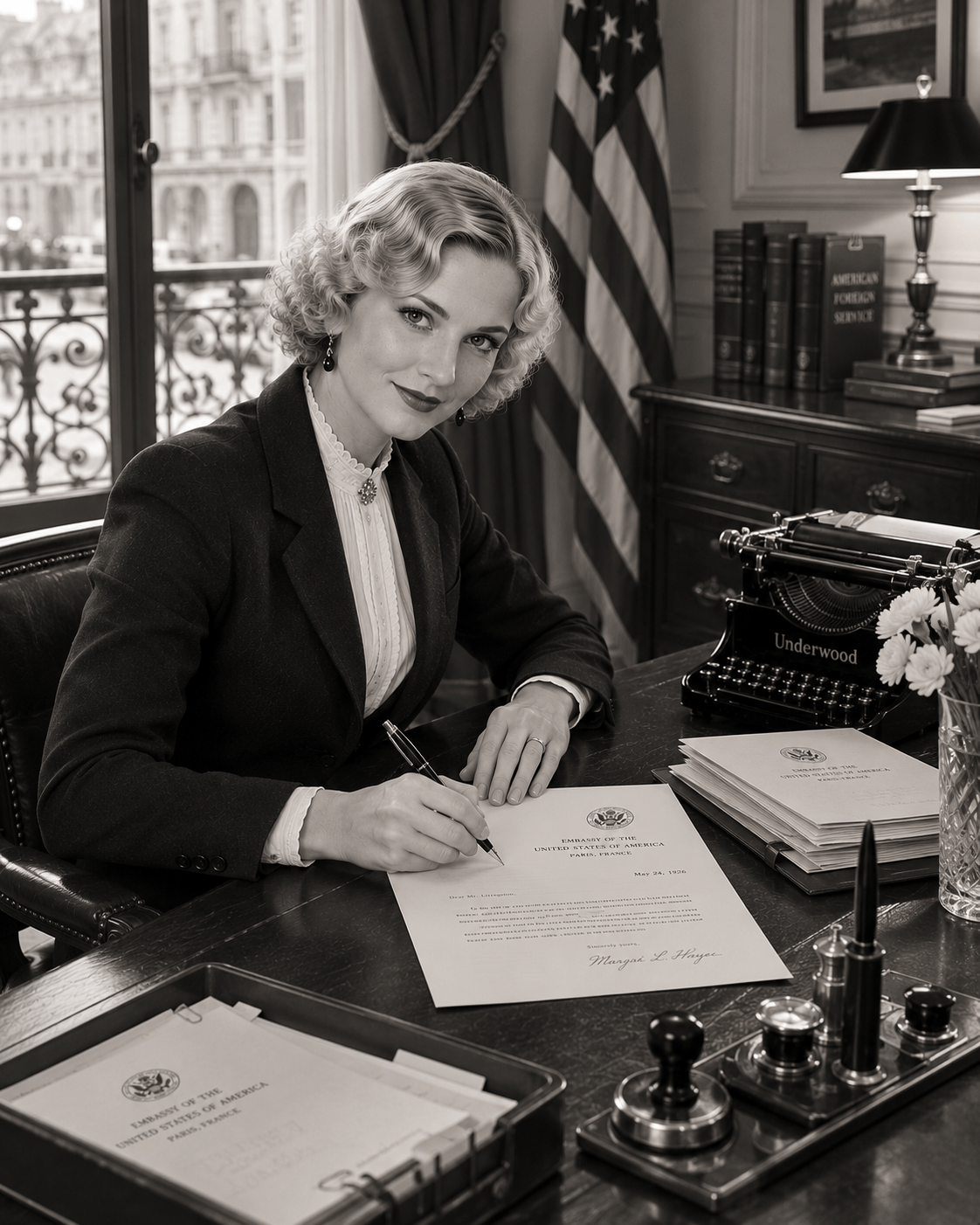
At the Chamber of Deputies, it is utter bedlam. The Herriot government just fell in two days, Poincaré is preparing to return to try to save the franc, and the ministries are spinning like windmills. Switching contacts at the Quai d’Orsay every Tuesday is starting to seriously exasperate Washington. The U.S. Embassy is desperately seeking a fixed point in this chaos. Someone who won’t fall at the slightest vote of confidence. That is why they reached out to me.
At 3:00 p.m. sharp, Margaret L. Hayes enters my office. Second Secretary. An understated suit, flawless blonde waves, a gaze of surgical precision. No useless preamble, no social niceties: this young woman clearly didn’t come here for tea.
She sets a thick file on the table and cuts straight to the point with typically American clarity. In ten sharp, figure-laden minutes, she maps out the problem for me:
1. The war debt: The Mellon-Bérenger Agreement is blocked because French public opinion refuses to sign as long as the franc crisis remains unresolved.
2. Financial stability: Wall Street is worried about a European economic collapse.
3. Political uncertainty: Washington no longer knows who to speak to in Paris.
Then comes the most delicious part. Once the assessment is laid out, she unrolls her list of expectations. At that point, it’s no longer a briefing—it’s the Bon Marché catalog:
Direct access to the Finance and Interior cabinets, bypassing protocol.
Discreet guarantees on American investments.
A reliable intelligence channel regarding left-wing movements and the streets of Paris.
And assistance in breaking through a few stubbornly French bureaucratic locks.
Just that. I watch her fire off her demands like a machine gun while maintaining an Olympian calm. If I let her talk for five more minutes, she’ll have me sign off on the handover of the Eiffel Tower and the keys to the Quai d’Orsay wine cellars.
—“Mademoiselle,” I tell her with a smile, “you are not looking for a collaboration; you are looking to annex the French civil service.”
She doesn’t flinch. She looks me straight in the eye, a faint smirk playing on her lips:
—“Ministers come and go, Monsieur. You remain. Washington wants to work with those who actually pull the strings.”
Touché. The agreement is quickly struck: I open my networks to smooth the way for American affairs in Paris, and she gives me direct, privileged access to the decision-making circles of the Embassy, and later of Washington.
Once the diplomat has left, I call on my contacts to find out who this young woman is, so utterly free of doubt. The reports reach me two hours later.
Margaret is not here by chance. She landed her post thanks to the Rogers Act of 1924, which finally opened the American diplomatic service to merit. But there is a far more interesting detail in her file: her name. Margaret is the direct granddaughter of Rutherford B. Hayes, the 19th President of the United States.
An heiress of the White House with the mind of a strategist and the boldness of a general. American diplomacy has just sent me a correspondent of the first order. The game promises to be a fascinating one.
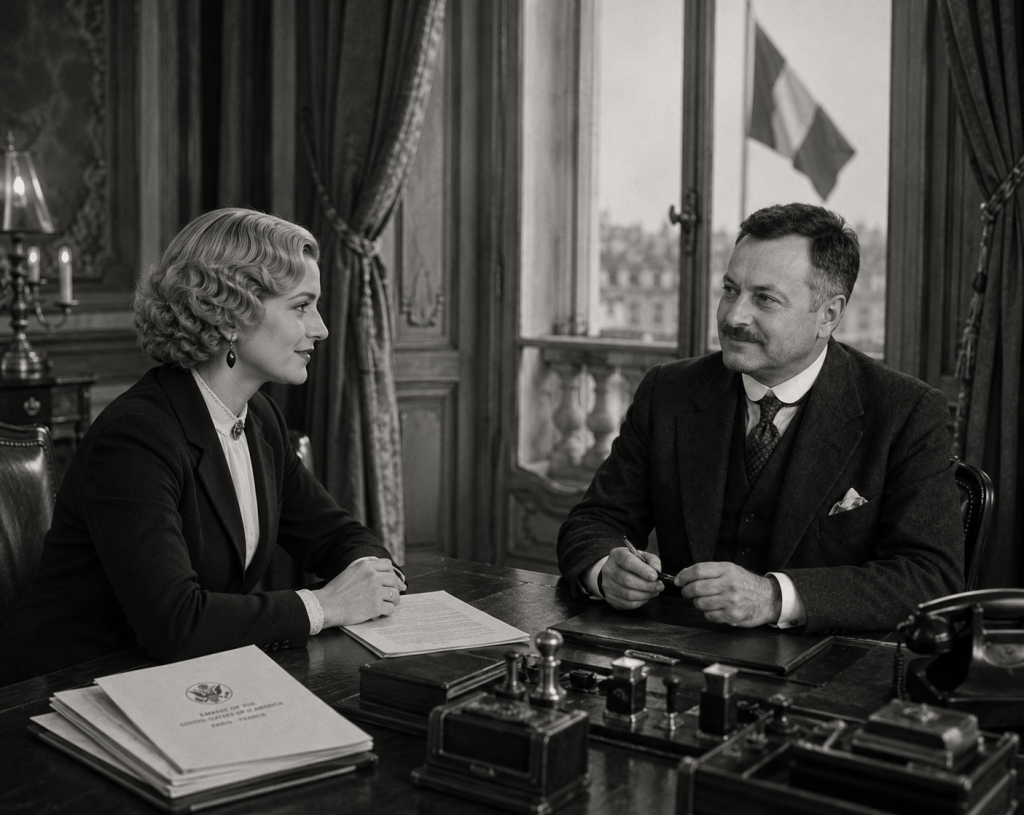
The meeting between Margaret L. Hayes and Olivier le Tigre
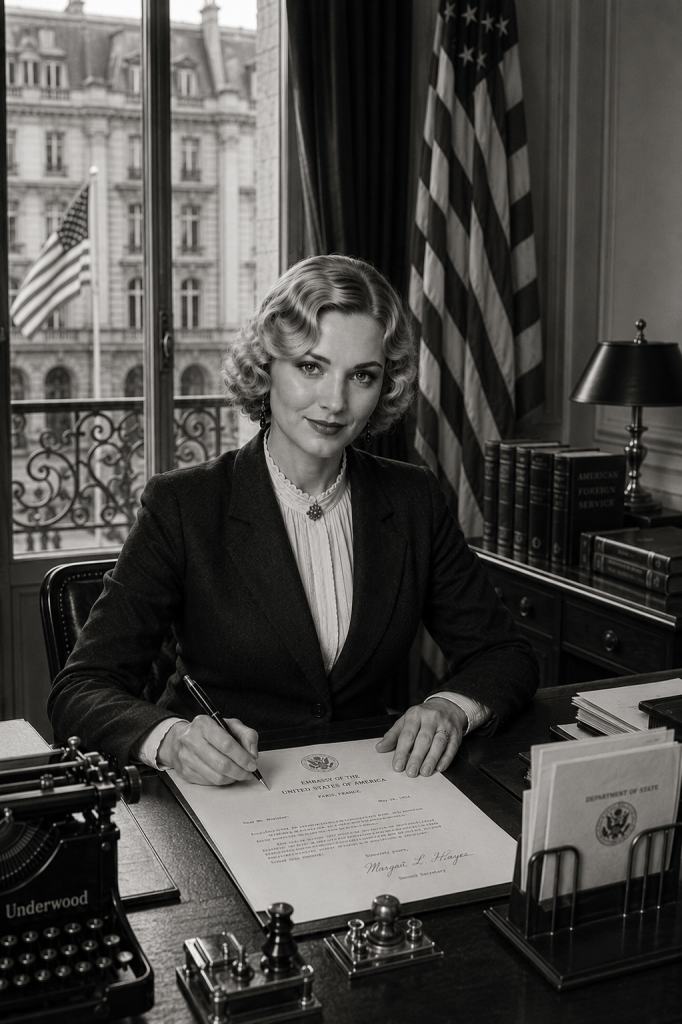
Margaeer L. Hayes is a fictional character inspired by the pioneer women of American diplomacy, such as Lucile Atcherson, posted in Bern as early as 1926, or Pattie H. Field, vice-consul in Amsterdam in 1925—both of whom entered service thanks to the Rogers Act of 1924. Her supposed grandfather, President Rutherford B. Hayes, did indeed exist, but their relation is fictional—a nod to his fight for a merit-based civil service, the fruits of which his fictional granddaughter reaps here.
 Il y a un siècle / A Century Ago
Laisser un commentaire