August 15, 1926: The Day My Daughter Left Clemenceau Speechless

Since Pauline’s departure for New York is now inevitable, I refuse to let her cross the Atlantic without solid footholds! To open the doors of American academia to her and secure the goodwill of influential allies on the ground, one obvious course of action presents itself: calling upon the man who knows America better than anyone else in the Republic—my former patron, Georges Clemenceau. And so, this morning, I take her to 8, rue Benjamin-Franklin.

The old chief receives us in his study, wearing his skullcap, his gaze as piercing as ever beneath thick white eyebrows. After the customary greetings, he fixes Pauline with a mock-stern glare:

“So, mademoiselle, I hear you want to go running off to the New World to dissect corpses and count comets among the oil barons? Does France no longer produce enough stars to keep you here?”

Far from being intimidated by “Père la Victoire,” Pauline holds his gaze with a faint, wry smile:

“It produces admirable ones, Monsieur le Président, but our university mandarins clearly prefer to observe them from a great height… especially when they wear a skirt! And if your own memoirs are anything to go by, you hardly asked anyone’s permission when you set off for America at twenty-four.”

A suspended silence falls over the room. I hold my breath. Then, a hearty roar of laughter lifts the old man’s bushy moustache. He slaps the table with the palm of his hand:

“By God! Olivier, your daughter has even sharper claws than you! At last, someone who doesn’t bother with bowing and scraping.”

Delighted by this feisty spirit, Clemenceau immediately takes up his pen. Rather than settling for a formal letter of introduction to Franklin Roosevelt, he chooses to write directly to his wife, Eleanor Roosevelt, knowing full well how dedicated she is to women’s emancipation in New York.

In a few brisk, warm lines, he introduces Pauline as a compatriot who is “tenacious, fearless, and worthy of the highest regard.” Pauline leaves Rue Franklin with the prized open-sesame in her pocket and a triumphant smile.

As for me, I breathe a little easier.

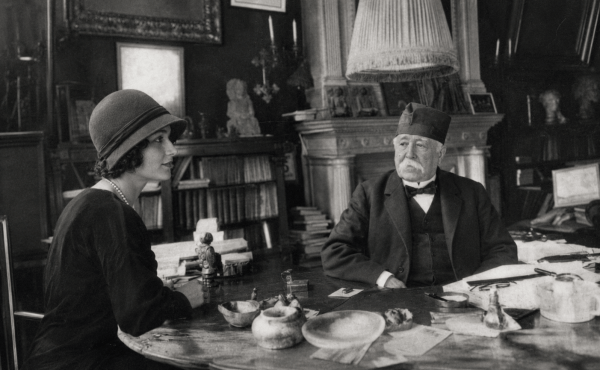
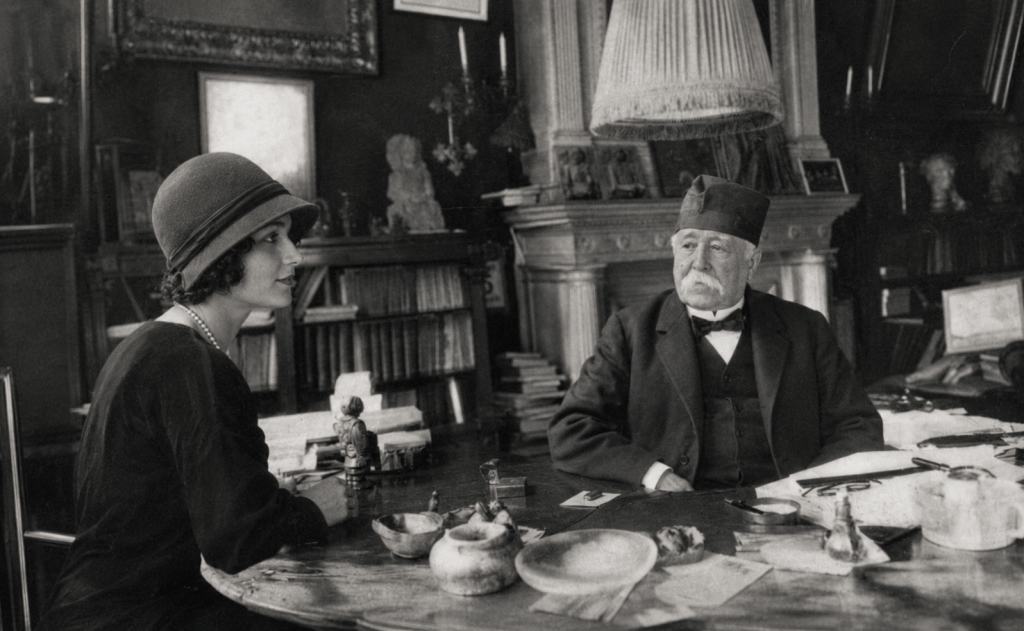
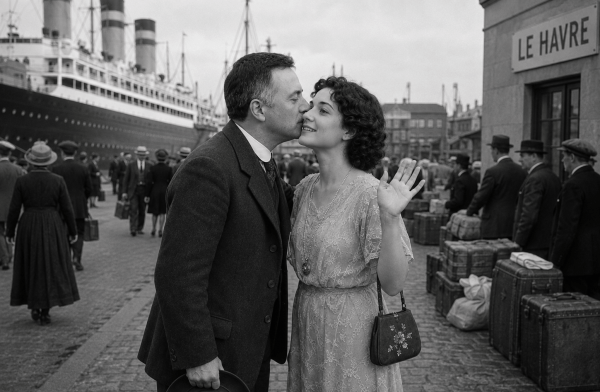
(Imaginary) photograph of the meeting between « The Tiger » and Pauline on August 15, 1926, at Clemenceau’s Parisian home on Rue Benjamin-Franklin (Clemenceau is passing through, between two extended stays at his house in Vendée).

The Historian’s Corner

1. 8, Rue Benjamin-Franklin: The Tiger’s Lair

Having stepped back from active politics following his defeat in the 1920 presidential election, Georges Clemenceau divided his time between his modest home in Saint-Vincent-sur-Jard (Vendée) and his Parisian apartment at 8, rue Benjamin-Franklin (in the 16th arrondissement, now a museum).

In this ground-floor flat opening onto a private garden, the “Père la Victoire” received close friends, former collaborators, and prominent international figures amidst thousands of books and his Asian art collection. Despite being 84 years old in 1926, he maintained a relentless work schedule, wearing his iconic skullcap and silk fingerless gloves to protect his skin, which had been sensitized by eczema.

2. Clemenceau the Physician: A Scientific Youth

Before becoming a journalist and statesman, Clemenceau was first a medical doctor. He defended his doctoral thesis in Paris in May 1865 (De la génération des éléments anatomiques / On the Generation of Anatomical Elements), deeply influenced by the positivism and scientific materialism of Auguste Comte and Charles Robin.

Although he practiced only briefly in the Montmartre district, he retained a lifelong fondness for medical practitioners and an enduring fascination with the natural and medical sciences.

3. The Formative Exile in the United States (1865–1869)

Freshly graduated and seeking to escape the authoritarian regime of Napoleon III, the 24-year-old Clemenceau sailed for the United States. He spent nearly four decisive years there:

  • Journalist: He served as a regular correspondent for the Parisian newspaper Le Temps, covering post-Civil War Reconstruction and offering incisive analyses of nascent American democratic institutions.
  • Teacher: He taught French and horseback riding at the Catharine Aiken School, a young women’s academy in Stamford, Connecticut.
  • Personal Life: There he met one of his students, Mary Plummer, whom he married in 1869 before returning to France.

This immersive stay allowed him to achieve fluent English and cultivate an extensive network of transatlantic friendships that lasted throughout his lifetime.

4. Why Eleanor Roosevelt in 1926?

Choosing to address a letter of recommendation to Eleanor Roosevelt rather than her husband Franklin was especially shrewd in 1926:

  • FDR’s relative withdrawal: After contracting polio in 1921, Franklin D. Roosevelt spent much of 1926 undergoing rehabilitation in Warm Springs, Georgia. He had not yet been elected Governor of New York (an office he would assume in 1928).
  • A woman of influence in Manhattan: During this period, Eleanor Roosevelt became the true political and civic driving force of the family in New York. A tireless activist, she was deeply involved with the Women’s Trade Union League (WTUL) and the League of Women Voters, and was preparing to buy a stake in the Todhunter School for girls, where she also taught.
  • A supportive female network: Passionately committed to women’s intellectual and professional emancipation, Eleanor Roosevelt was the ideal ally to help guide a young Frenchwoman navigating the American metropolis.

5. The Clemenceau–Roosevelt Connection

Clemenceau shared a mutual admiration with the Roosevelt family, particularly with former Republican President Theodore Roosevelt (Eleanor’s uncle), whom he had met during his travels and with whom he shared a pugnacious temperament and legendary outspokenness.

During his final, triumphant speaking tour across the United States in late 1922, Clemenceau had rekindled his political and social contacts along the East Coast—making his intercession with the Roosevelt circle both entirely natural and highly effective.

15 août 1926 : Le jour où ma fille a cloué le bec à Clemenceau

Puisque le départ de Pauline pour New York est désormais inéluctable, je refuse de la laisser traverser l’Atlantique sans de solides points d’ancrage ! Pour lui ouvrir les portes du monde universitaire américain et lui garantir la bienveillance d’alliés influents sur place, une évidence s’impose : solliciter l’homme qui connaît l’Amérique mieux que quiconque dans la République, mon ancien patron, Georges Clemenceau. Je l’emmène donc ce matin au 8, rue Benjamin-Franklin.

Le vieux chef nous reçoit dans son cabinet, calotte sur la tête, le regard toujours aussi perçant sous ses épais sourcils blancs. Après les salutations d’usage, il fixe Pauline d’un air faussement sévère :

« Alors, mademoiselle, il paraît que vous voulez courir le Nouveau Monde pour disséquer des cadavres et compter les comètes chez les marchands de pétrole ? La France ne produit plus assez d’étoiles pour vous retenir ? »

Loin d’être intimidée par le « Père la Victoire », Pauline soutient son regard avec un demi-sourire narquois :

« Elle en produit d’admirables, Monsieur le Président, mais nos mandarins de faculté préfèrent visiblement les observer de très haut… surtout lorsqu’elles portent une jupe ! Et si j’en crois vos propres mémoires, vous n’aviez guère demandé la permission à grand monde lorsque vous êtes parti pour l’Amérique à vingt-quatre ans. »

Un silence suspendu s’installe. Je retiens mon souffle. Puis, une franche détonation de rire soulève l’épaisse moustache du vieil homme. Il frappe la table du plat de la main :

« Parbleu ! Olivier, votre fille a encore plus de griffes que vous ! Voilà au moins quelqu’un qui ne s’embarrasse pas de salamalecs. »

Ravi par ce tempérament combatif, Clemenceau saisit aussitôt sa plume. Plutôt que de s’en tenir à une lettre protocolaire pour Franklin Roosevelt, il choisit d’écrire directement à son épouse, Eleanor Roosevelt, sachant combien celle-ci est engagée pour l’émancipation des femmes à New York.

En quelques lignes nerveuses et chaleureuses, il présente Pauline comme une compatriote « tenace, intrépide et digne du plus grand intérêt ». Pauline repart de la rue Franklin avec le précieux sésame en poche et un sourire victorieux. Quant à moi, je respire un peu mieux.

Photo (imaginaire) de la rencontre entre Le Tigre et Pauline, le 15 août 1926, au domicile parisien de Clemenceau, rue Benjamin-Franklin (Clemenceau est de passage, entre deux longs séjours dans sa maison en Vendée)

Le coin de l’historien

1. Le 8, rue Benjamin-Franklin : l’antre du Tigre

Retiré de la vie politique active depuis son échec à l’élection présidentielle de 1920, Georges Clemenceau partage son temps entre sa bicoque vendéenne de Saint-Vincent-sur-Jard et son appartement parisien du 8, rue Benjamin-Franklin (dans le XVIᵉ arrondissement, aujourd’hui transformé en musée).

Dans ce rez-de-chaussée donnant sur un jardin, le « Père la Victoire » reçoit ses proches, d’anciens collaborateurs et des personnalités internationales au milieu de milliers d’ouvrages et de ses collections d’art asiatique. Malgré ses 84 ans en 1926, il conserve un rythme de travail acharné, coiffé de sa célèbre calotte et portant ses mitaines en soie pour protéger sa peau fragilisée par l’eczéma.


2. Clemenceau médecin : une jeunesse scientifique

Avant de devenir journaliste et homme d’État, Clemenceau a d’abord été médecin. Il soutient sa thèse en mai 1865 à Paris (De la génération des éléments anatomiques), sous l’influence du positivisme et du matérialisme scientifique d’Auguste Comte et de Charles Robin. Bien qu’il n’ait exercé que brièvement dans le quartier de Montmartre, il a toujours conservé une affection particulière pour les praticiens et une fascination pour les sciences naturelles et médicales.


3. L’exil formateur aux États-Unis (1865-1869)

À peine diplômé, fuyant le régime autoritaire de Napoléon III, le jeune Clemenceau s’embarque pour les États-Unis à l’âge de 24 ans. Il y passe près de quatre années décisives :

  • Journaliste : Il devient le correspondant régulier du journal parisien Le Temps, couvrant la reconstruction américaine au lendemain de la guerre de Sécession et analysant avec acuité les institutions démocratiques naissantes.
  • Enseignant : Il enseigne le français et l’équitation dans une institution pour jeunes filles de Stamford (Connecticut), la Catharine Aiken School.
  • Vie personnelle : Il y rencontre l’une de ses élèves, Mary Plummer, qu’il épouse en 1869 avant de rentrer en France.

Cette immersion lui a permis de maîtriser parfaitement la langue anglaise et d’entretenir tout au long de sa vie un réseau dense d’amitiés outre-Atlantique.


4. Pourquoi Eleanor Roosevelt en 1926 ?

Le choix d’adresser une lettre de recommandation à Eleanor Roosevelt plutôt qu’à son mari Franklin est particulièrement pertinent en 1926 :

  • Un FDR en retrait relatif : Après avoir contracté la poliomyélite en 1921, Franklin D. Roosevelt passe une grande partie de l’année 1926 en Géorgie (à Warm Springs) pour suivre sa rééducation. Il n’est pas encore gouverneur de New York (il le deviendra en 1928).
  • Une femme d’influence à Manhattan : Durant cette période, Eleanor Roosevelt devient le véritable bras politique et social de la famille à New York. Militante infatigable, elle est très active au sein de la Women’s Trade Union League (WTUL), de la League of Women Voters et s’apprête à acquérir des parts dans la Todhunter School, une école pour jeunes filles où elle enseigne.
  • Un réseau d’entraide féminin : Très engagée en faveur de l’émancipation intellectuelle et professionnelle des femmes, Eleanor Roosevelt représente le point de contact parfait pour aider une jeune Française à s’orienter dans la métropole américaine.

5. Les liens Clemenceau – Roosevelt

Clemenceau entretenait une estime réciproque avec la branche Roosevelt, notamment avec le président républicain Theodore Roosevelt (l’oncle d’Eleanor), qu’il avait rencontré lors de ses voyages et avec lequel il partageait un tempérament pugnace et un franc-parler légendaire. Lors de son ultime tournée triomphale aux États-Unis à la fin de l’année 1922, Clemenceau avait réactivé tous ses contacts politiques et mondains sur la côte Est, ce qui rend son intercession auprès du cercle Roosevelt tout à fait naturelle et efficace.

August 10, 1926: Pauline Wants to Move to New York!

“Father, I am leaving for the United States!” Pauline, my twenty-year-old daughter, doesn’t beat around the bush. It isn’t even “I would like to”—no: she wants to.

“But with what money, my dear?” I retorted, believing I held the ultimate argument to hold her back.

She then detailed the savings she had patiently set aside working as a nurse alongside her medical studies. Above all, Pauline stressed her need for a change of scene, to indulge in astronomy—her passion—in a city like New York that is captivated by science, and to complete her medical degree in an environment far more welcoming to women than our French faculties. She is already dreaming of reaching out to Columbia’s astronomy department or attending public lectures at the American Museum of Natural History, while hoping to join the College of Physicians and Surgeons or Cornell’s medical school. She insists she can live on “next to nothing,” that her English is perfectly respectable, and that, in any case, her mind is made up.

My wife, with whom she had already discussed the matter, wholeheartedly supports the initiative: “Olivier, I assure you, it is a wonderful thing for her. Pauline is radiant. Let us let her fly the nest!”

It is true. Never has my daughter’s gaze revealed such a blend of determination, serene happiness, and steadfast confidence in the future.

It now falls to me to reach out to a few well-placed contacts to keep her from lodging in the metropolis’s unsavory quarters—such as the infamous surrounds of Hell’s Kitchen or the Bowery—and to ease her parents’ minds. I am thinking in particular of my former chief Clemenceau, who lived over there for a long time, is perfectly bilingual, and knows the Roosevelt family well. I could also reach back out to Margaret L. Hayes, the diplomat from the U.S. Embassy with whom I had an interview the other day, couldn’t I?

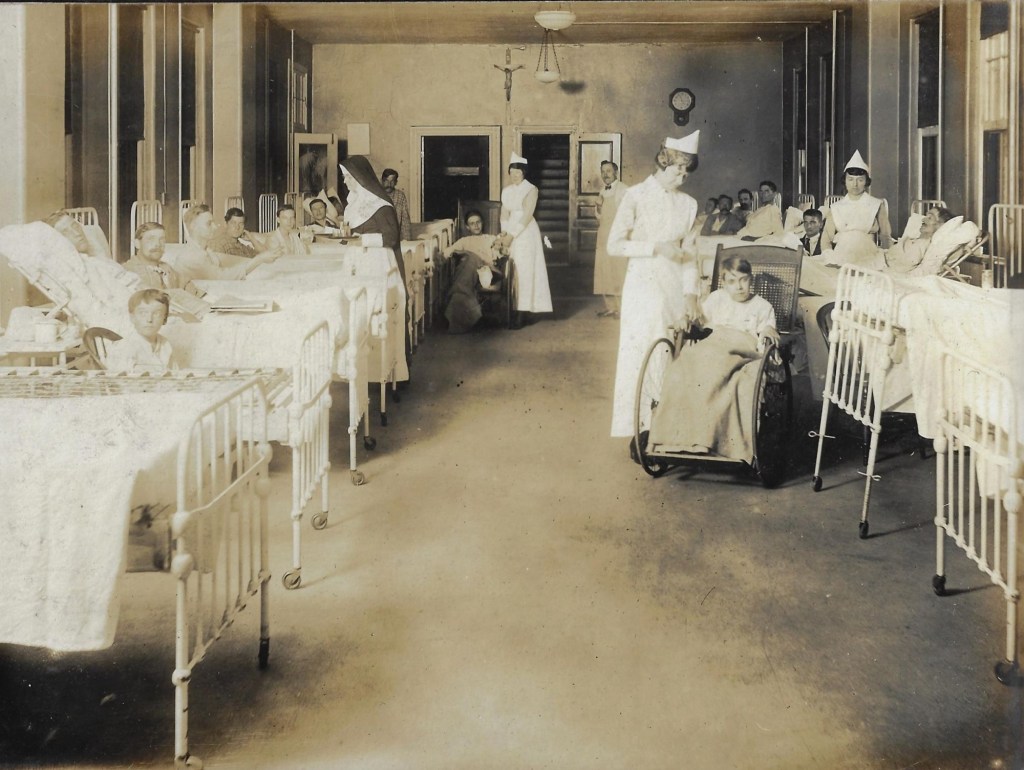
The main ward of an American hospital in the 1920s

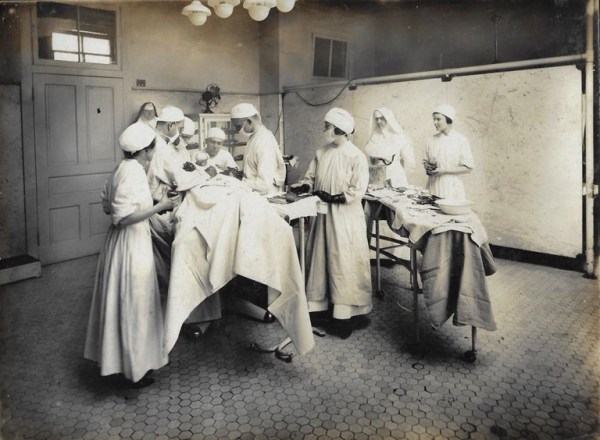
An operating room in an American hospital in the 1920s

The Historian’s Corner

Studying Medicine as a Woman in New York in 1926:

In France, medical studies had been open to women since the late 19th century, but the academic environment remained steeped in conservatism. In the United States, the situation evolved more rapidly in certain major institutions: Cornell University Medical College had been coeducational since its founding in 1898, and Columbia University’s College of Physicians and Surgeons opened its doors to female students in 1917. Furthermore, New York hospitals offered significant clinical internship opportunities for female practitioners.

Astronomy in New York Before the Hayden Planetarium:

In 1926, New York was buzzing with scientific excitement. The American Museum of Natural History (AMNH) was the beating heart of popular astronomy thanks to Dr. Clyde Fisher, who brought together enthusiasts and academics for highly sought-after public lectures (he would go on to found the Amateur Astronomers Association the following year). At Columbia, the astronomy department was undergoing major modernization: Pupin Hall and its Rutherfurd Observatory were under construction at the time and would open in 1927.

Crime and Safety in New York Under Prohibition:

Since the implementation of the Volstead Act in 1920, the sale of alcohol had been illegal in the United States. By 1926, organized crime (led by figures such as Lucky Luciano, Meyer Lansky, and Frankie Yale) controlled the city. Neighborhoods like Hell’s Kitchen (the stronghold of Irish gangs controlling the docks) and the Bowery (riddled with speakeasies, illegal gambling, and tensions in nearby Chinatown) were considered particularly dangerous for a young woman on her own.

Georges Clemenceau and His American Network:

The “Tiger” knew the United States intimately, having lived there from 1865 to 1869. While there, he worked as a correspondent for the newspaper Le Temps, taught French at a girls’ school in Stamford, Connecticut, and married an American woman, Mary Plummer. Fluently bilingual, he maintained influential political and diplomatic connections there, notably within Theodore Roosevelt’s circle.

10 août 1926 : Pauline veut s’installer à New-York !

« Papa, je vais partir pour les États-Unis ! » Pauline, ma fille de vingt ans, n’y va pas par quatre chemins. Ce n’est même pas « je souhaite », non : elle veut.

« Mais avec quel argent, ma chérie ? » rétorqué-je, pensant tenir là l’argument ultime pour la retenir.

Elle me détaille alors les sommes qu’elle a patiemment mises de côté en travaillant comme garde-malade en parallèle de ses études de médecine. Pauline insiste surtout sur son besoin de changer d’air, de s’adonner à l’astronomie — sa passion — dans une ville comme New York qui se passionne pour la science, et d’y achever son cursus médical dans un environnement bien plus ouvert aux femmes que nos facultés françaises. Elle rêve déjà d’approcher le département d’astronomie de Columbia ou d’assister aux conférences publiques de l’American Museum of Natural History, tout en espérant intégrer le College of Physicians and Surgeons ou l’école de médecine de Cornell. Elle affirme qu’elle peut vivre « avec presque rien », que son anglais est très correct et que, de toute façon, sa décision est prise.

Ma femme, avec laquelle elle a déjà eu cette conversation, soutient pleinement l’initiative : « Olivier, je t’assure, c’est une excellente chose pour elle. Pauline est rayonnante. Laissons-la sortir du nid ! »

C’est vrai. Le regard de ma fille n’a jamais révélé un tel mélange de détermination, de bonheur paisible et de ferme assurance face à l’avenir.

Il me reste à solliciter quelques relations facilitatrices pour lui éviter de loger dans les secteurs peu recommandables de la métropole — comme les environs malfamés de Hell’s Kitchen ou du Bowery — et tranquilliser ses parents. Je pense notamment à mon ancien patron Clemenceau, qui a longtemps vécu là-bas, est parfaitement bilingue et connaît bien la famille Roosevelt. Je pourrais aussi recontacter Margaret L. Hayes, la diplomate de l’ambassade des États-Unis avec laquelle j’ai eu un entretien l’autre jour ?

Une salle d’opération dans un hôpital aux États-Unis dans les années 20

La grande salle d’un hôpital américain dans les années 20

Le coin de l’historien

 Étudier la médecine en tant que femme à New York en 1926 :

En France, les études médicales sont ouvertes aux femmes depuis la fin du XIXᵉ siècle, mais le milieu universitaire reste imprégné de conservatisme. Aux États-Unis, la situation évolue plus vite dans certaines grandes institutions : le Cornell University Medical College est mixte depuis sa fondation en 1898, et le College of Physicians and Surgeons de Columbia University a ouvert ses portes aux étudiantes en 1917. Les hôpitaux new-yorkais offrent en outre d’importantes opportunités d’internat clinique pour les femmes praticiennes.

 L’astronomie à New York avant le planetarium Hayden :

En 1926, New York est en pleine effervescence scientifique. L’American Museum of Natural History (AMNH) est le cœur battant de la vulgarisation astronomique grâce au Dr Clyde Fisher, qui réunit passionnés et universitaires lors de conférences publiques très courues (il fondera l’Amateur Astronomers Association l’année suivante). À Columbia, le département d’astronomie est en pleine modernisation : le bâtiment Pupin Hall et son observatoire Rutherfurd sont alors en chantier et ouvriront leurs portes en 1927.

 L’insécurité new-yorkaise sous la Prohibition :

Depuis la mise en œuvre du Volstead Act en 1920, la vente d’alcool est illégale aux États-Unis. En 1926, la pègre organisée (emmenée par des figures comme Lucky Luciano, Meyer Lansky ou Frankie Yale) contrôle la ville. Des quartiers comme Hell’s Kitchen (fief des gangs irlandais contrôlant les docks) ou le Bowery (maillé par les speakeasies, le jeu clandestin et les tensions de Chinatown) sont réputés particulièrement dangereux pour une jeune femme seule.

 Georges Clemenceau et son réseau américain :

Le « Tigre » connaît parfaitement les États-Unis pour y avoir vécu de 1865 à 1869. Il y a exercé comme correspondant pour le journal Le Temps, enseigné le français dans un collège de jeunes filles à Stamford (Connecticut) et épousé une Américaine, Mary Plummer. Parfaitement bilingue, il y a conservé d’importants relais politiques et diplomatiques, notamment auprès du cercle de Theodore Roosevelt.

August 1, 1926: Nothing Must Go Off the Rails in the Mines!

The soap in the great earthenware washbasin can do nothing about it. This coal dust, fine and clinging as chimney soot, stays lodged beneath my nails and in the creases of my palms. However hard I scrub, it wins out: it settles into the grain of the writing paper on which I set down these lines, in small black traces I no longer dare wipe away.
Looking at them, I measure the distance that separates the plush carpets of the Rue de Rivoli from the bottom of Pit 11.
Raymond Poincaré has sent me to the North with a fixed idea in mind: to determine whether our coal basins can bear the strain of the monetary war effort without tipping the country into a general strike. Tonight, in the silence of this room at the Hôtel de la Gare in Lens, where one can still almost hear, far off, the panting of a coal convoy, I have my answer.


This Morning’s Descent
Nothing prepares you for the cage as it drops. We say “go down” — the word is far too gentle. It is a controlled fall, four hundred metres down a black shaft, the stomach lurching upward, and then, all at once, the stop, the silence, and that damp heat seizing you by the throat like a hand. The air is thick with dust and sweat; the lamp at the belt pierces no more than a metre ahead of one’s feet.
Walking before me is Henri de Peyerimhoff, president of the Comité Central des Houillères — that great jurist out of the Conseil d’État who has become the true spokesman of the mining employers. He advances without a moment’s hesitation into the darkness, as though he knew every gallery by heart. Peyerimhoff wished to show me “his place of work” before any discussion took place, “so that I might see for myself,” as he put it.
Rounding a coalface, we come upon three men, bare-chested, their skin gleaming, black with coal down into the very creases of their wrinkles. Two young Poles, arrived on recent convoys of the Société Générale d’Immigration, and a strapping local lad, native to Lens or Hénin. Together, muscles straining to breaking point, they heave forward a tram wagon of at least five hundred kilos, on makeshift rails, in a grinding of iron that all but drowns out their breathing.
It is this force — raw, silent — that drives the entire economy of the country, and that one so easily forgets from behind a desk in Paris.


The Tram Wagon
Then, with a metallic crash that echoes down the whole gallery, the wagon jumps its rails. The mass of iron tips dangerously, threatening to fall upon the legs of one of the Poles, who struggles to hold it back. The shift foreman comes running and shouts an order — which the man, not understanding a word of French, cannot carry out. I see the miners’ eyes harden around us; something, in the already unbreathable air, grows taut.
It is here that Peyerimhoff shows his true face. He does not lose his temper. The former magistrate lays a firm hand on the foreman’s shoulder and says, without raising his voice, with a cold authority sufficient to cut the panic short:
“Calm yourselves. The language barrier calls for method, not shouting. If this wagon overturns, or a man is hurt, we lose two hours of output, and we sow resentment for months to come.”
With a gesture, he sends for a bilingual worker. Within barely two minutes, the order is translated, the wagon righted and set back on its rails, and work resumes — quietly, almost as though nothing had happened. Only the men’s eyes, still a shade too fixed, say otherwise.


Black Coffee
Back at the surface, in the management office, over a black and bitter coffee that strikes me as the best I have tasted in weeks, the exchange remains grave. Peyerimhoff pushes the production ledgers toward me, then fixes me with that lucid, almost weary gaze worn by men accustomed to carrying heavy decisions alone:
“You see it for yourself, Monsieur le Conseiller. Discipline is not maintained through threats. If we want the mines to supply the coal needed to stabilise the Franc, these men must be treated with method and with justice. Safety in the coalfaces, decent wages, respect for the contracts of our immigrants: these are not concessions. They are the very conditions of productivity.”
“That is precisely the analysis of the cabinet in Paris, Monsieur de Peyerimhoff,” I reply. “The State will lend its support for transport and equipment. But we shall be inflexible on the protection of the miners and the enforcement of the rules. We shall not save the currency on the backs of the men from the pit.”
He nods, satisfied, it seems, to find that the government yields neither to demagogy nor to old-style employer brutality.


Night Over the Slag Heaps
It is late now. Through my window, the slag heaps cast enormous shadows into the northern night, like black hills set down there by mistake. I return to Paris tomorrow, still a little dust beneath my nails, with a certainty that will not leave me: with men of Peyerimhoff’s calibre, a pact of reason between the State and heavy industry is possible.
Whether it will hold, once I am gone, remains to be seen.

« Rounding a coalface, we come upon three men, bare-chested, their skin gleaming, black with coal down into the very creases of their wrinkles. Two young Poles, arrived on recent convoys of the Société Générale d’Immigration, and a strapping local lad, native to Lens or Hénin. »
„Walking before me is Henri de Peyerimhoff, president of the Comité Central des Houillères — that great jurist out of the Conseil d’État who has become the true spokesman of the mining employers.“

Propulsé par WordPress.com.

Retour en haut ↑