July 22, 1926: The American Woman Who Wanted to Annex the Republic

At the Chamber of Deputies, it is utter bedlam. The Herriot government just fell in two days, Poincaré is preparing to return to try to save the franc, and the ministries are spinning like windmills. Switching contacts at the Quai d’Orsay every Tuesday is starting to seriously exasperate Washington. The U.S. Embassy is desperately seeking a fixed point in this chaos. Someone who won’t fall at the slightest vote of confidence. That is why they reached out to me.

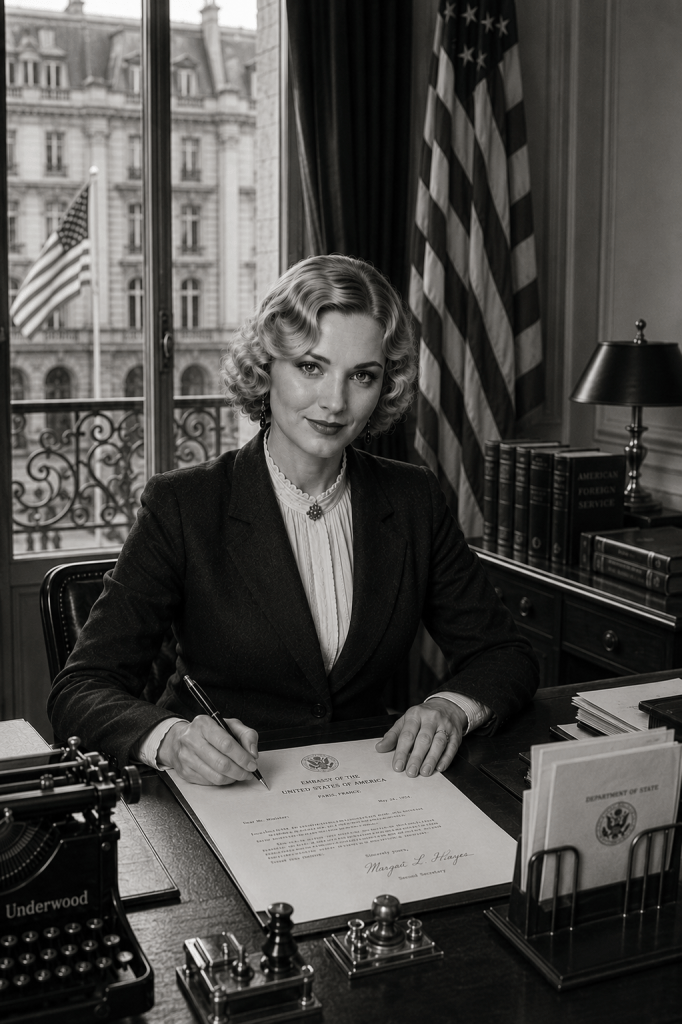
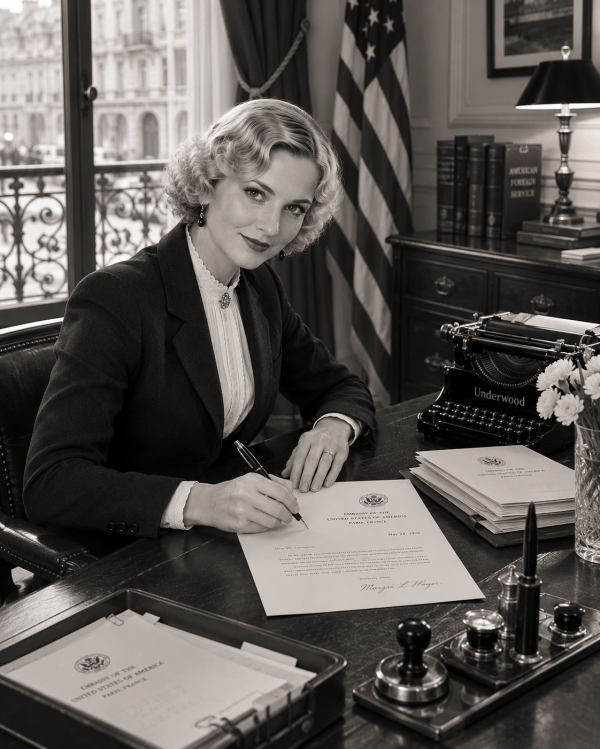
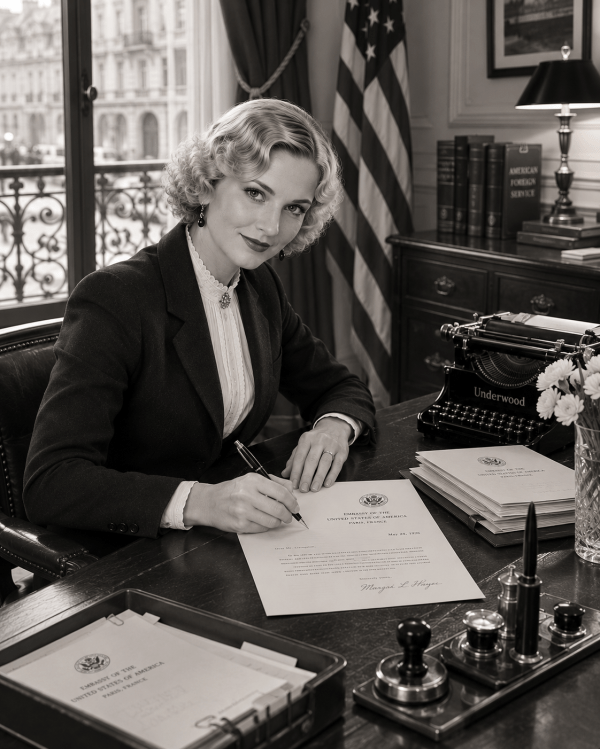
At 3:00 p.m. sharp, Margaret L. Hayes enters my office. Second Secretary. An understated suit, flawless blonde waves, a gaze of surgical precision. No useless preamble, no social niceties: this young woman clearly didn’t come here for tea.

She sets a thick file on the table and cuts straight to the point with typically American clarity. In ten sharp, figure-laden minutes, she maps out the problem for me:

1. The war debt: The Mellon-Bérenger Agreement is blocked because French public opinion refuses to sign as long as the franc crisis remains unresolved.

2. Financial stability: Wall Street is worried about a European economic collapse.

3. Political uncertainty: Washington no longer knows who to speak to in Paris.

Then comes the most delicious part. Once the assessment is laid out, she unrolls her list of expectations. At that point, it’s no longer a briefing—it’s the Bon Marché catalog:

 Direct access to the Finance and Interior cabinets, bypassing protocol.

 Discreet guarantees on American investments.

 A reliable intelligence channel regarding left-wing movements and the streets of Paris.

 And assistance in breaking through a few stubbornly French bureaucratic locks.

Just that. I watch her fire off her demands like a machine gun while maintaining an Olympian calm. If I let her talk for five more minutes, she’ll have me sign off on the handover of the Eiffel Tower and the keys to the Quai d’Orsay wine cellars.

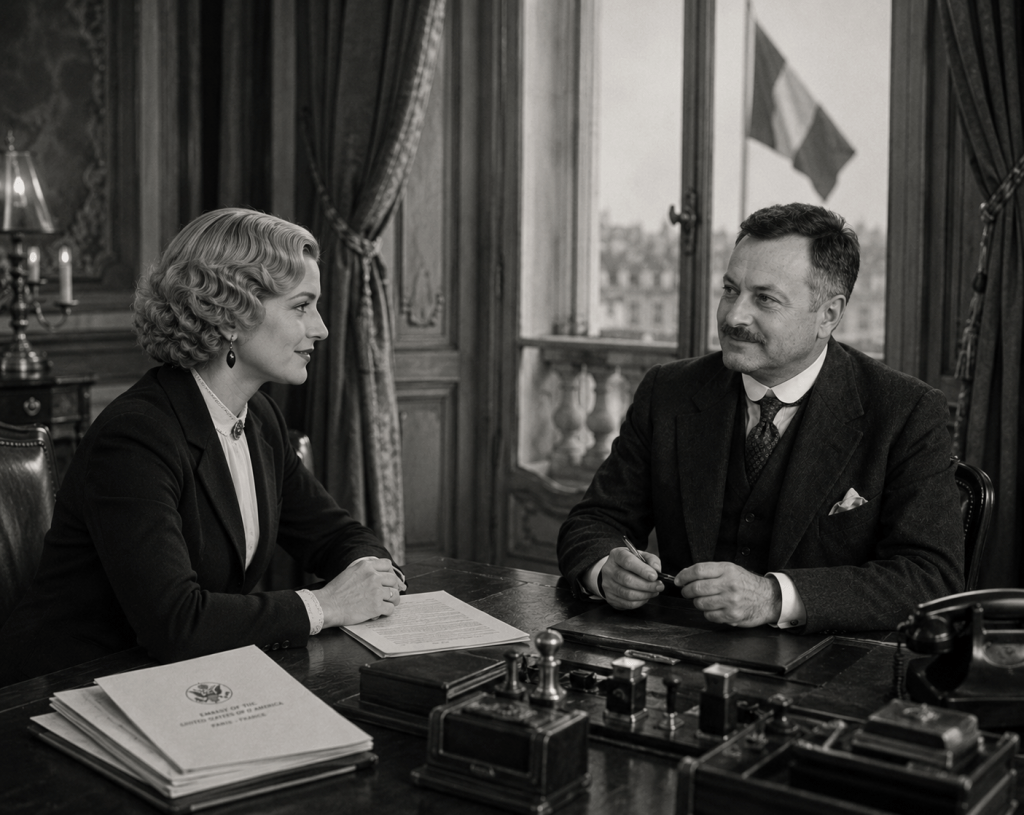
—“Mademoiselle,” I tell her with a smile, “you are not looking for a collaboration; you are looking to annex the French civil service.”

She doesn’t flinch. She looks me straight in the eye, a faint smirk playing on her lips:

—“Ministers come and go, Monsieur. You remain. Washington wants to work with those who actually pull the strings.”

Touché. The agreement is quickly struck: I open my networks to smooth the way for American affairs in Paris, and she gives me direct, privileged access to the decision-making circles of the Embassy, and later of Washington.

Once the diplomat has left, I call on my contacts to find out who this young woman is, so utterly free of doubt. The reports reach me two hours later.

Margaret is not here by chance. She landed her post thanks to the Rogers Act of 1924, which finally opened the American diplomatic service to merit. But there is a far more interesting detail in her file: her name. Margaret is the direct granddaughter of Rutherford B. Hayes, the 19th President of the United States.

An heiress of the White House with the mind of a strategist and the boldness of a general. American diplomacy has just sent me a correspondent of the first order. The game promises to be a fascinating one.
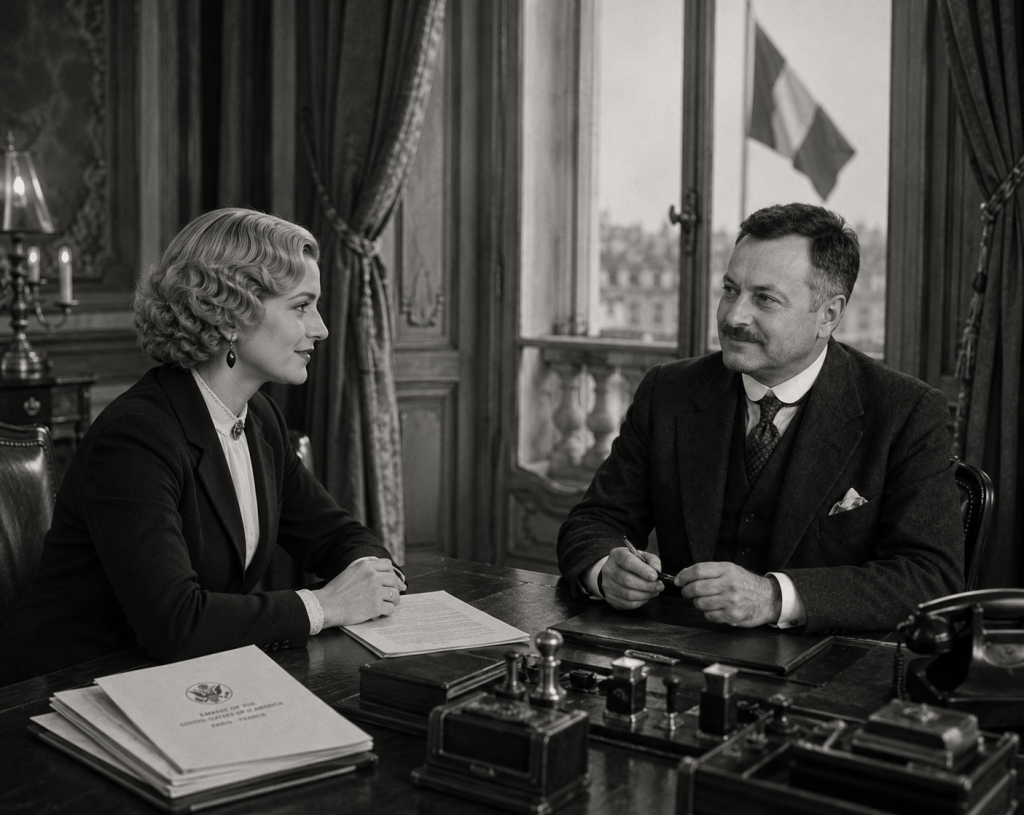

The meeting between Margaret L. Hayes and Olivier le Tigre
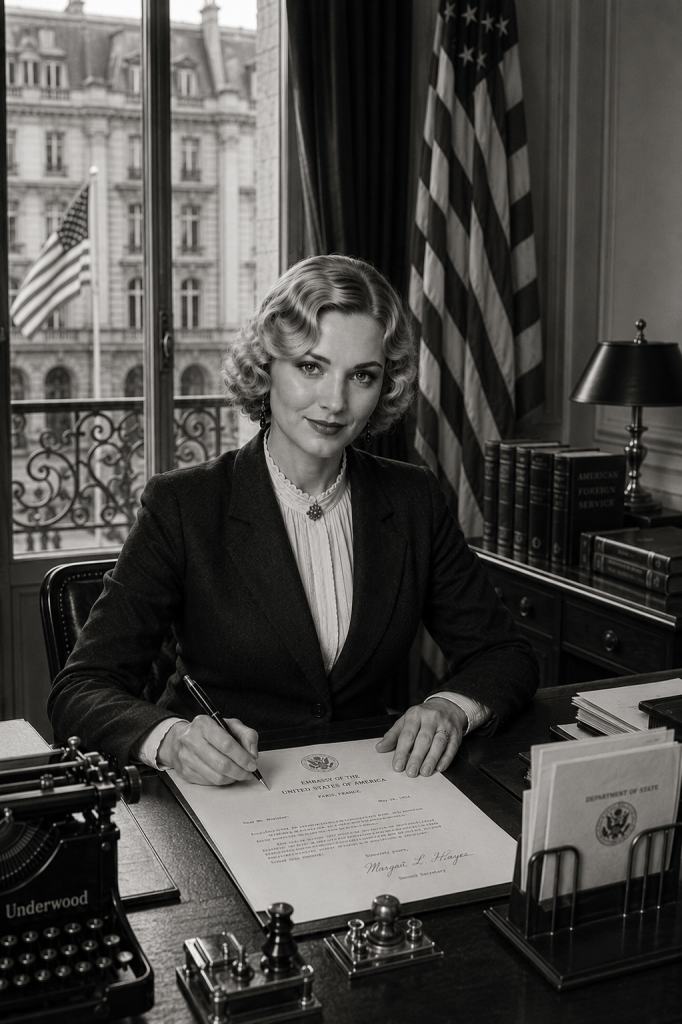

Margaeer L. Hayes is a fictional character inspired by the pioneer women of American diplomacy, such as Lucile Atcherson, posted in Bern as early as 1926, or Pattie H. Field, vice-consul in Amsterdam in 1925—both of whom entered service thanks to the Rogers Act of 1924. Her supposed grandfather, President Rutherford B. Hayes, did indeed exist, but their relation is fictional—a nod to his fight for a merit-based civil service, the fruits of which his fictional granddaughter reaps here.
22 juillet 1926 : L’Américaine qui voulait annexer la République

À la Chambre des députés, c’est la cohue. Le gouvernement Herriot vient de sauter en deux jours, Poincaré s’apprête à revenir pour tenter de sauver le franc, et les ministères tournent au moulin à vent. Changer d’interlocuteur au Quai d’Orsay chaque mardi commence à exaspérer sérieusement Washington. L’ambassade des États-Unis cherche désespérément un point fixe dans cette pagaille. Quelqu’un qui ne saute pas au moindre vote de confiance. C’est pour cela qu’on m’a sollicité.

À 15 heures précises, Margaret L. Hayes entre dans mon bureau. Deuxième Secrétaire. Tailleur sobre, ondulations blondes impeccables, regard d’une précision chirurgicale. Aucun préambule inutile, pas de fioritures mondaines : cette jeune femme n’est clairement pas venue pour boire le thé.

Elle pose un dossier rigide sur la table et entre dans le vif du sujet avec une pédagogie typiquement américaine. En dix minutes chiffrées et tranchantes, elle me cartographie le problème :

1. La dette de guerre : L’accord Mellon-Bérenger est bloqué parce que l’opinion française refuse de signer tant que la crise du franc n’est pas réglée.

2. La stabilité financière : Wall Street s’inquiète d’un effondrement économique européen.

3. Le flou politique : Washington ne sait plus à qui parler à Paris.

Puis vient le moment le plus savoureux. Une fois le constat posé, elle déballe sa liste d’attentes. Et là, ce n’est plus un exposé, c’est le catalogue du Bon Marché :

 Un accès direct aux cabinets des Finances et de l’Intérieur, sans passer par le protocole.

 Des garanties discrètes sur les investissements américains.

 Un canal d’information fiable sur les mouvements de la gauche et la rue parisienne.

 Et une aide pour faire sauter quelques verrous bureaucratiques bien français.

Rien que ça. Je la regarde dérouler ses exigences à la mitrailleuse avec un calme olympien. Si je la laisse parler cinq minutes de plus, elle me demande de lui signer la cession de la Tour Eiffel et les clés des caves du Quai d’Orsay.

— Mademoiselle, lui dis-je en souriant, vous ne cherchez pas une collaboration, vous cherchez à annexer l’administration française.

Elle ne cille pas. Elle me fixe droit dans les yeux, un léger sourire en coin :

— Les ministres passent, Monsieur. Vous, vous restez. Washington veut travailler avec ceux qui tiennent réellement les ficelles.

Touché. L’accord est vite conclu : je lui ouvre mes réseaux pour fluidifier les affaires américaines à Paris, et elle devient mon accès direct et privilégié aux cercles de décision de l’Ambassade puis de Washington.

Une fois la diplomate partie, je fais jouer mes contacts pour vérifier qui est cette jeune femme qui ne doute de rien. Les rapports me parviennent deux heures plus tard.

Margaret n’est pas là par hasard. Elle a décroché son poste grâce au Rogers Act de 1924, qui a enfin ouvert le service diplomatique américain au mérite. Mais il y a un détail autrement plus intéressant dans son dossier : son nom. Margaret est la petite-fille directe de Rutherford B. Hayes, le 19ᵉ président des États-Unis.

Une héritière de la Maison-Blanche avec la tête d’un stratège et l’audace d’un général. La diplomatie américaine vient de m’envoyer une correspondante de premier ordre. La partie promet d’être passionnante.

La rencontre entre Margaret L. Hayes et Olivier le Tigre


Margaret L. Hayes est un personnage fictif inspiré des premières femmes de la diplomatie américaine, comme Lucile Atcherson, en poste à Berne dès 1926, ou Pattie H. Field, vice-consule à Amsterdam en 1925 — toutes deux entrées en fonction grâce au Rogers Act de 1924. Son grand-père supposé, le président Rutherford B. Hayes, a bien existé, mais leur filiation est inventée — clin d’œil à son combat pour une fonction publique fondée sur le mérite, dont sa petite-fille fictive récolte ici les fruits.

Propulsé par WordPress.com.

Retour en haut ↑