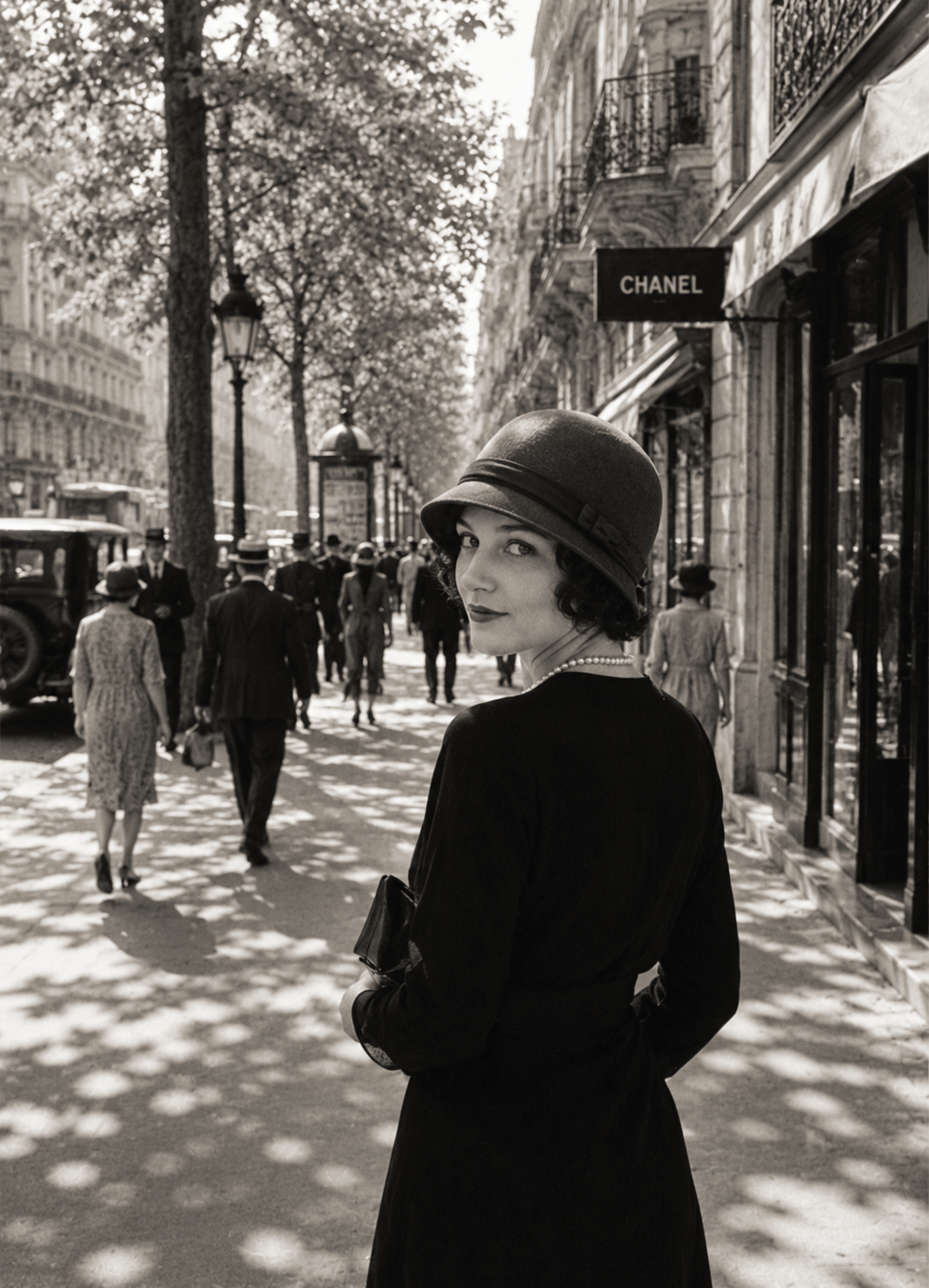
It’s quite a visual shock, even for a guy who claims to have seen it all. Sitting on the terrace of the Café de la Paix, I watched the silhouettes drift by before realizing that the one walking so purposefully toward my table was none other than my daughter. Pauline. A moving little black rectangle beneath a cloche hat pulled right down to her eyes. No more long hair—a short bob, and a black dress that stops dead below the knee. She sat down opposite me with a wide, radiant smile.
“So, Papa? Have you seen my Ford?” she threw out by way of greeting.
I couldn’t help but smile.
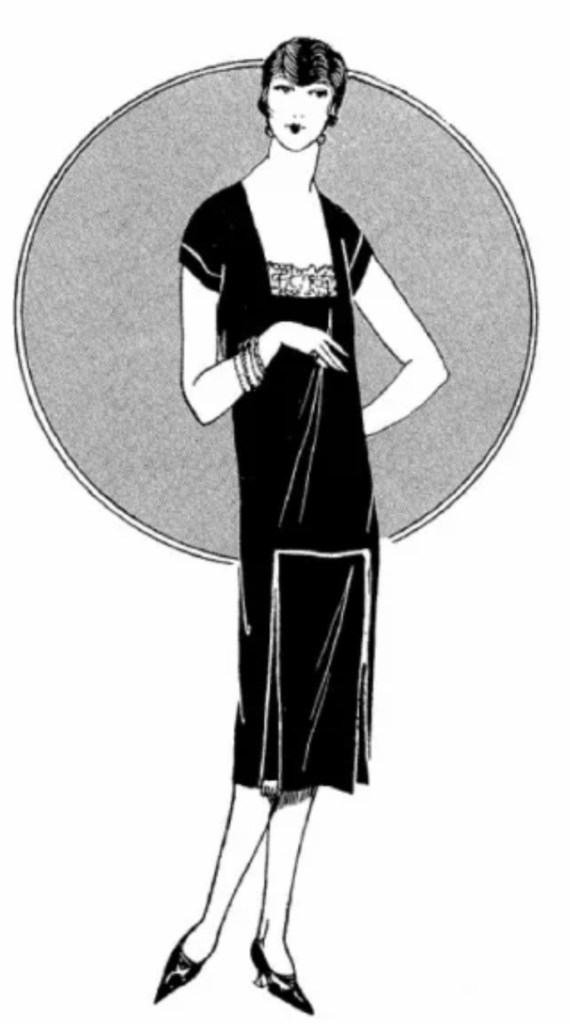
“Your Ford? I knew American industry worked miracles, but I didn’t think you could wear it on your back. It’s Chanel, isn’t it? I recognize the style, but I’m worried about my wallet…”
“Don’t worry, Papa!” she laughed, patting my hand. “It is indeed the model Vogue dubbed that way. Except I made it myself. Thirty francs’ worth of fabric, a pattern cut out of a magazine, three evenings of sewing, and voilà. That’s Paris in 1926 for you: we no longer wait on the salons of Rue Cambon to be elegant. Typists and duchesses look exactly the same on the street.”
I looked at her with a touch of admiration. I knew the women of the Belle Époque—tightly corseted, prisoners of their own frills and flounces. My daughter, however, can breathe. The S-curve silhouette has completely vanished, replaced by a fluid line—a true garçonne look.
“I must admit it’s much more practical for chasing after the tramway,” I said with a smile. “But aren’t you a bit cold without all that armor?”
“On the contrary, Papa, we’re alive again!” she replied, adjusting her dress where it sat on her hips. “We threw it all out the window. A bandeau bra, a girdle, and that’s it. We want to be able to move, play sports, dance the Charleston without suffocating. And look at my arms, I’ve caught the sun!”
“That, I can see. Your saintly grandmother would have screamed scandal at the sight of that tan—she who never went out without her parasol.”
“Your saintly mother didn’t see Josephine Baker at the Théâtre des Champs-Élysées. Today, porcelain skin is over. We want life!”
She pulled a mirror from her bag to touch up her lipstick, brazenly, right in front of the passersby. Total freedom, without a shred of false bourgeois modesty. Watching her, my mind drifted back to last year’s Art Deco Exhibition.
“You remind me of poor Paul Poiret,” I told her in a gentler tone. “I ran into him last week. His three pharaonic barges—Amours, Délices, and Orgues—have completely ruined him. He still clings to his oriental drapes, his splendors of another era… It’s sad, but the emperor has no clothes.”
Pauline cast an almost tender look for the old couturier.
“He was a genius, but he stayed on the other side of the war. Today’s women want structure, speed. Look at what Sonia Delaunay is doing with her Boutique Simultanée: cubism in motion, diamonds, geometric lines. It’s wearable art, not theater costumes.”
She gulped down the rest of her coffee, flashed me a conspiratorial look, and stood up, already hurried along by her era.
“Right, I must fly, Papa. See you tonight at the dance hall? I’ll show you how we dance in 1926.”
“Agreed! I rather enjoy letting myself be led from time to time!” I called out with a laugh.
Watching her walk away with a light step into the boulevard crowd, I felt an immense warmth. This fashion isn’t a mere youthful whim. It is their manifesto. These women don’t just walk; they charge ahead, free and masters of their own bodies. And honestly, watching the world change at this pace through my daughter’s eyes is the finest show in Paris.

Pauline, Olivier le Tigre’s daughter, wears her Chanel « Ford » dress, which she sewed herself.
1920s Fashion in Paris: Revolution, Garçonnes, and Haute Couture


Votre commentaire