August 23, 1926: Pauline Packs Her Trunks for New York

For anyone joining our story mid-stride, let me summarize the tempest: my twenty-one-year-old daughter, Pauline, has decided to slam the door on the French medical establishment to conquer New York, its universities, and its astronomical observatories. My old boss, Georges Clemenceau, thoroughly won over by the young lady’s audacity, has already provided her with a choice passport to high society: a personal letter addressed to Eleanor Roosevelt. As for me, having just been tasked by Raymond Poincaré with quietly negotiating behind the scenes with Margaret L. Hayes—a brilliant diplomat at the American Embassy and the granddaughter of a former president—to steady the franc on Wall Street, I was left with the task of turning this headstrong whim into a flawlessly orchestrated landing.

This morning, Pauline’s bedroom looks like an expeditionary army’s staging camp. In the center of the room sit two bulky, domed trunks of coated canvas, fortified—mercifully—with brass fittings. No milliner’s frivolities here: my daughter is outfitting her voyage like a merchant marine officer. I watch her systematically stack Testut’s hefty Treatise of Human Anatomy, her star-gazing logbooks crammed with equations, her stethoscope, and a small refracting telescope swaddled in three layers of woolen sweaters.

“Not a single evening gown for New York?” I ask, bemused, lifting a bundle of white lab coats.

“You don’t observe the Andromeda Nebula in a crinoline, Father,” she shoots back without looking up. “And at Columbia, I doubt the microscopes care much for lace.”

At two in the afternoon, I leave this cheerful chaos to meet Margaret L. Hayes in the hushed lounge of a grand hotel on the Place de la Concorde. The Second Secretary welcomes me with her leather-bound notebook and a black coffee. I swiftly cover the essentials on the political front: Poincaré’s ironclad resolve, the impending creation of the autonomous sinking fund to secure Treasury bonds, and the opening of our backchannel to reassure Washington.

Margaret jots down a few quick notes, gives an approving nod, and snaps her notebook shut:

“Splendid. The markets will welcome Monsieur Poincaré’s firmness. But if I read between the lines correctly, Olivier, you didn’t request this meeting merely to hold forth on war debts.”

“Indeed. Now that the franc is well on its way to recovery, let us settle a far more delicate matter: my daughter arrives on your shores at the end of the month.”

For a fraction of a second, Miss Hayes’s mask of diplomatic composure cracks, giving way to a knowing smile. She draws two typewritten official documents from a folder:

“I anticipated your request. Pauline will travel second class aboard the French Line’s ocean liner Paris. That will spare her the ordeal of Ellis Island: customs clearance will be conducted directly on board before docking at the Manhattan pier. As for accommodation, I have secured her a room at International House on Riverside Drive, just steps from the Columbia campus. It is modern, well-supervised, and cosmopolitan. And finally, here is her consular letter of introduction.”

I gaze at the papers stamped with the American eagle. Between the handwritten note from “The Tiger” to Mrs. Roosevelt and the embassy’s backing, Pauline is about to cross the Atlantic flanked by an invisible yet formidable escort.

“Well, Miss Hayes… you certainly don’t do things by halves.”

Margaret straightens her tailored jacket, her eyes twinkling:

“Rest assured, Olivier: with patrons like these, your daughter won’t merely set foot in New York… she is going to take full possession of it.”
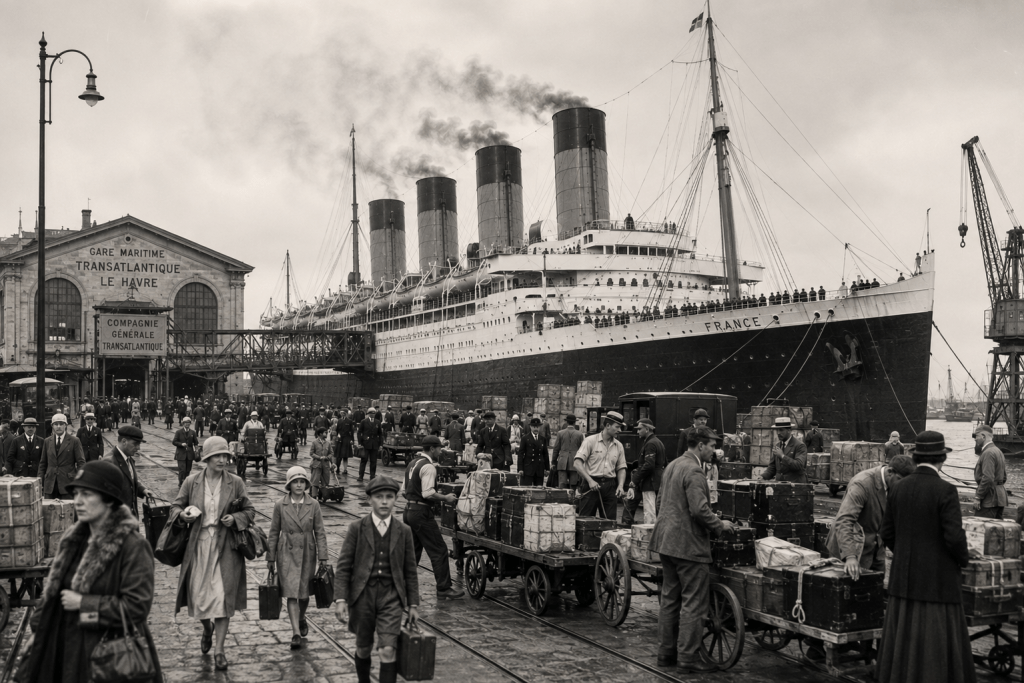
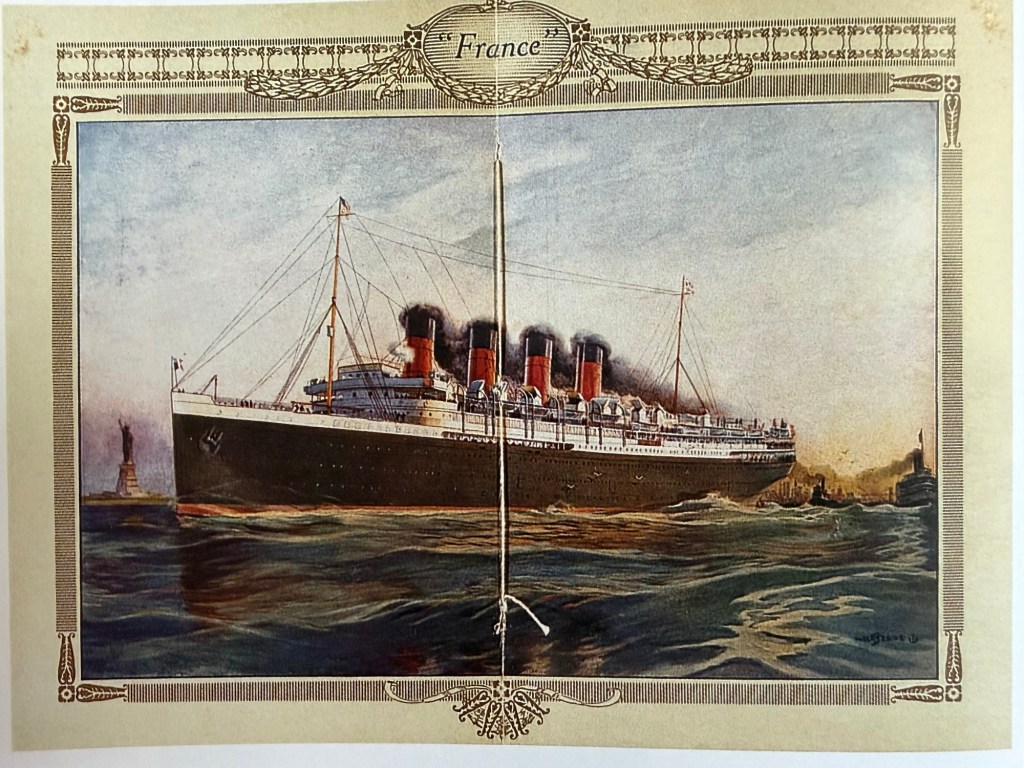
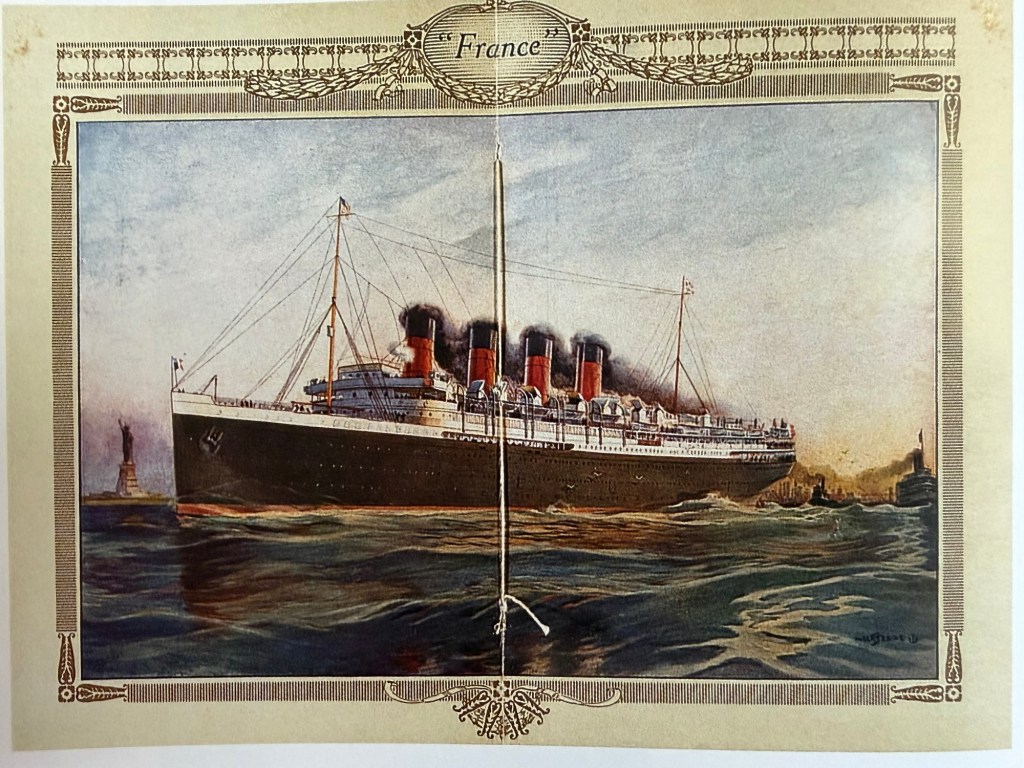
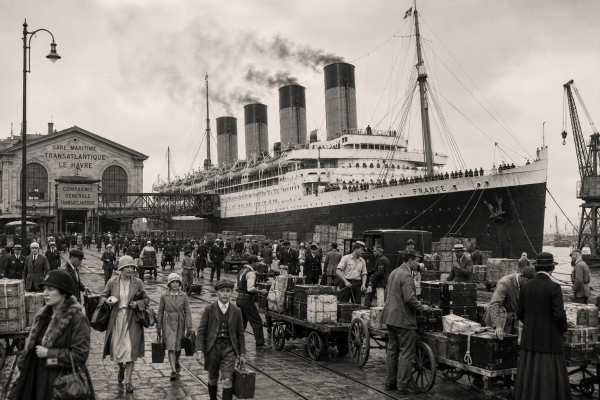
The ocean liner France in the port of Le Havre in 1926. (Reconstruction based on archival records)

The ocean liner France (Compagnie Générale Transatlantique, entered service in 1912) — Length: 217.6 m (714 ft) | Gross tonnage: 23,769 GRT. Cruising speed: 24 knots (approx. 27.6 mph / 44.5 km/h), linking Le Havre to New York in under six days. Capacity: 1,920 passengers (534 in first class, 442 in second class, 944 in third class) and a crew of 540.

The Historian’s Corner: America and France in the Summer of 1926

The Art of Trunks and Transatlantic Logistics: Packing for a six-day ocean crossing was an exacting science, strictly regulated by shipping lines:

  • The Cabin Trunk (steamer trunk): Bearing the regulatory “Wanted on voyage” label, it was restricted in height (roughly 14 inches) to slide beneath the berth, or took the form of a vertical wardrobe trunk fitted with hangers and lockable drawers. It contained undergarments, daytime attire, toiletries, and reading material needed for life on board.
  • The Hold Trunk (“Not wanted on voyage”): Substantially heavier and more voluminous, reinforced with beechwood slats and brass corner brackets, it held surplus clothing, linens, instruments, and heavy volumes like the Testut treatise. Once loaded into the hold, it remained entirely inaccessible until disembarkation.
  • Protection from Sea Air: The North Atlantic’s salty dampness and condensation in the cargo holds required rigorous precautions: watertight trunks lined with zinc or vulcanized fiber, sheets of tissue paper placed between fabrics to preserve delicate textiles, and camphor balls to protect wool and leather bindings from mildew.
  • Rail Transit: In Paris, travelers checked their baggage at the Gare Saint-Lazare using color-coded tags from the Compagnie Générale Transatlantique (indicating the vessel, class, and stateroom number). Trunks were transported via dedicated baggage vans directly to the Le Havre departure pier and hoisted aboard by dockside cranes.

Bypassing Ellis Island for Cabin Passengers: In the 1920s, first- and second-class passengers were spared the ordeal of the Ellis Island immigration depot. Administrative processing, visa inspections, and routine health checks were conducted directly on board by American officials before the ship docked at the Hudson River piers in Manhattan. Only steerage (third-class) passengers were transferred by ferry to the island for comprehensive medical examinations and rigorous questioning.

New York’s International House: Opened in September 1924 at 500 Riverside Drive, across from Riverside Church and right next to Columbia University, this grand student residence was established through the philanthropy of John D. Rockefeller Jr. and the Dodge family. Designed to foster intellectual exchange among students from across the globe, it provided foreign scholars with a modern, secure, and cosmopolitan environment.

Léo Testut’s Treatise of Human Anatomy: A monumental four-volume work lavishly illustrated by Gaston Devy (and later revised with André Latarjet), the “Testut” formed the undisputed cornerstone of French medical education. For a student like Pauline, taking her own set to New York was both a heavy physical undertaking and a badge of pride, representing the rigorous standard of the Parisian clinical method.

Poincaré’s Financial Plan and the Autonomous Sinking Fund: Confronted with an acute currency crisis in July 1926, Raymond Poincaré assumed both the Premiership and the Finance portfolio. To halt speculation against the franc without bowing to the aggressive demands of Anglo-American creditors, he secured parliamentary approval for 11 billion francs in new taxes and established the Autonomous Fund for the Management of National Defense Bonds (Caisse autonome de gestion des bons de la Défense nationale), which was permanently enshrined in the French Constitution by the Parliament convened in Congress at Versailles on August 10, 1926.
22 août 1926 : Pauline prépare ses malles pour New-York

Pour qui prendrait notre histoire en marche, résumons la tempête : ma fille Pauline, 21 ans, a décidé de claquer la porte du mandarinat médical français pour conquérir New York, ses facultés et ses observatoires d’astronomie. Mon vieux patron Georges Clemenceau, conquis par le toupet de la demoiselle, lui a déjà signé un sauf-conduit de choix : une lettre personnelle pour Eleanor Roosevelt. De mon côté, alors que Raymond Poincaré vient de me charger de négocier en sous-main avec Margaret L. Hayes — brillante diplomate de l’ambassade américaine et petite-fille de président — pour stabiliser le franc auprès de Wall Street, il me restait à transformer ce coup de tête en débarquement parfaitement orchestré.

Ce matin, la chambre de Pauline ressemble à un camp de départ d’une armée en expédition. Au milieu de la pièce trônent deux volumineuses malles bombées en toile enduite et – heureusement – renforcées de laiton. Pas de futilités de modiste ici : ma fille prépare son expédition comme un officier de marine marchande. Je la regarde empiler avec méthode l’épais Traité d’anatomie de Testut, ses cahiers d’observations stellaires noircis d’équations, son stéthoscope et une petite lunette emmaillotée dans trois couches de chandails de laine.

— Pas une seule robe de soirée pour New York ? m’étonné-je en soulevant un paquet de blouses blanches.

— On n’observe pas la nébuleuse d’Andromède en crinoline, papa, me rétorque-t-elle sans lever les yeux. Et à Columbia, je doute que les microscopes s’émeuvent de la dentelle.

À quatorze heures, je quitte ce joyeux désordre pour retrouver Margaret L. Hayes dans le salon feutré d’un grand hôtel de la place de la Concorde. La Deuxième Secrétaire m’accueille avec son carnet relié de cuir et un café noir. J’expédie l’essentiel sur le front politique : la détermination d’airain de Poincaré, la création imminente de la Caisse autonome pour garantir les bons du Trésor et l’ouverture de notre canal confidentiel pour rassurer Washington.

Margaret prend des notes rapides, esquisse un hochement de tête approbateur, puis referme son carnet d’un coup sec :

— Parfait. Les marchés apprécieront la fermeté de Monsieur Poincaré. Mais si je lis bien entre vos lignes, Olivier, vous n’avez pas demandé cet entretien uniquement pour disserter sur la dette de guerre.

— En effet. Maintenant que le franc est en voie de sauvetage, réglons une affaire bien plus délicate : ma fille débarque chez vous à la fin du mois.

L’espace d’une seconde, le masque d’impassibilité diplomatique de Miss Hayes se fissure pour laisser place à un sourire complice. Elle sort d’une chemise cartonnée deux documents officiels dactylographiés :

— J’ai devancé votre requête. Pauline voyagera en seconde classe sur le paquebot Paris de la Compagnie Générale Transatlantique. Cela lui évitera les tracasseries d’Ellis Island : les formalités de douane se feront directement à bord avant d’accoster au quai de Manhattan. Pour le logement, je lui ai réservé une chambre à l’International House, sur Riverside Drive, à deux pas du campus de Columbia. C’est moderne, surveillé et cosmopolite. Enfin, voici sa lettre d’introduction consulaire.

Je contemple les papiers tamponnés de l’aigle américain. Entre le mot manuscrit du « Tigre » pour Mrs Roosevelt et les appuis de l’ambassade, Pauline s’apprête à traverser l’Atlantique avec une escorte invisible mais redoutable.

— Eh bien, Miss Hayes… vous ne faites pas les choses à moitié.

Margaret réajuste sa veste de tailleur, le regard pétillant :

— Rassurez-vous, Olivier : avec de tels parrains, votre fille ne va pas simplement poser le pied à New York… elle va en prendre possession.

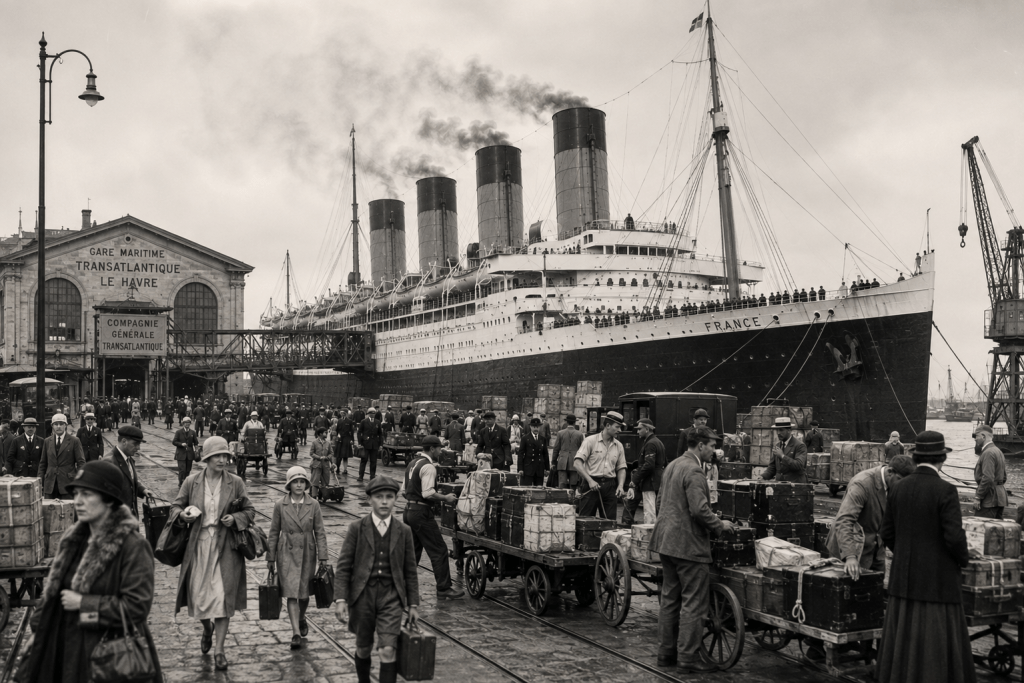
Le paquebot France dans le port du Havre en 1926. (Reconstitution à partir d’archives)

Le paquebot France (Compagnie Générale Transatlantique, mis en service en 1912) — Longueur : 217,6 m | Jauge : 23 769 tonneaux. Vitesse de croisière : 24 nœuds (environ 44,5 km/h), reliant Le Havre à New York en moins de six jours. Capacité : 1 920 passagers (534 en 1ʳᵉ classe, 442 en 2ᵈᵉ classe, 944 en 3ᵉ classe) et 540 membres d’équipage.

Le coin de l’historien : l’Amérique et la France à l’été 1926

  • L’art des malles et la logistique des traversées transatlantiques : Faire ses bagages pour une traversée de six jours relevait d’une mécanique de précision, codifiée par les compagnies maritimes :
    • La malle-cabine (steamer trunk) : Portant l’étiquette réglementaire « Wanted on voyage », elle était limitée en hauteur (environ 35 cm) pour se glisser sous la couchette, ou prenait la forme d’une malle-armoire verticale (wardrobe) munie de cintres et de tiroirs verrouillables. Elle renfermait le linge de corps, les tenues de jour, les affaires de toilette et les lectures nécessaires à la vie de bord.
    • La malle de cale (« Not wanted on voyage ») : Beaucoup plus lourde et volumineuse, renforcée de lattes de hêtre et de cornières en laiton, elle accueillait les réserves de vêtements, le linge de maison, les instruments et les livres pesants comme le Testut. Une fois chargée à bord, elle demeurait inaccessible jusqu’au débarquement.
    • La protection contre l’air marin : L’humidité saline de l’Atlantique Nord et la condensation dans les cales exigeaient des précautions strictes : malles étanches doublées de zinc ou de toile vulcanisée, interposition de papier de soie pour préserver les étoffes et usage de boules de camphre pour protéger la laine et les reliures en cuir des moisissures.
    • L’acheminement ferroviaire : Dès Paris, le voyageur enregistrait ses bagages à la gare Saint-Lazare avec les étiquettes de couleur de la Compagnie Générale Transatlantique (indiquant le paquebot, la classe et le numéro de cabine). Les malles étaient acheminées par fourgon spécial directement sur le quai d’embarquement au Havre et hissées à bord par les grues portuaires.
  • L’évitement d’Ellis Island pour les passagers de cabine : Dans les années 1920, les passagers de première et deuxième classe échappaient au centre d’immigration d’Ellis Island. Les formalités administratives, le contrôle des visas et l’inspection sanitaire sommaire étaient réalisés directement à bord par les officiers américains avant l’accostage aux terminaux de l’Hudson River à Manhattan. Seuls les passagers de troisième classe (l’entrepont) étaient transbordés par ferry vers l’îlot pour subir les examens médicaux complets et les interrogatoires.
  • L’International House de New York : Ouverte en septembre 1924 au 500 Riverside Drive, face à Riverside Church et à proximité immédiate de l’Université Columbia, cette grande résidence universitaire a été fondée grâce aux mécénats de John D. Rockefeller Jr. et de la famille Dodge. Conçue pour favoriser les échanges intellectuels entre étudiants du monde entier, elle offrait aux jeunes chercheurs étrangers un cadre moderne, sécurisé et cosmopolite.
  • Le Traité d’anatomie humaine de Léo Testut : Ouvrage monumental en quatre volumes abondamment illustrés par Gaston Devy (puis révisé avec André Latarjet), le « Testut » formait le socle absolu de l’enseignement médical français. Pour une étudiante comme Pauline, transporter son exemplaire à New York constituait à la fois un investissement matériel lourd et la marque d’excellence de la méthode clinique parisienne.
  • Le plan financier de Poincaré et la Caisse autonome : Face à la crise monétaire aiguë de juillet 1926, Raymond Poincaré cumule la présidence du Conseil et le portefeuille des Finances. Pour enrayer la spéculation contre le franc sans céder aux exigences brutales des créanciers anglo-saxons, il fait voter 11 milliards de francs d’impôts nouveaux et crée la Caisse autonome de gestion des bons de la Défense nationale, pérennisée dans la Constitution par le Parlement réuni en Congrès à Versailles le 10 août 1926.

August 15, 1926: The Day My Daughter Left Clemenceau Speechless

Since Pauline’s departure for New York is now inevitable, I refuse to let her cross the Atlantic without solid footholds! To open the doors of American academia to her and secure the goodwill of influential allies on the ground, one obvious course of action presents itself: calling upon the man who knows America better than anyone else in the Republic—my former patron, Georges Clemenceau. And so, this morning, I take her to 8, rue Benjamin-Franklin.

The old chief receives us in his study, wearing his skullcap, his gaze as piercing as ever beneath thick white eyebrows. After the customary greetings, he fixes Pauline with a mock-stern glare:

“So, mademoiselle, I hear you want to go running off to the New World to dissect corpses and count comets among the oil barons? Does France no longer produce enough stars to keep you here?”

Far from being intimidated by “Père la Victoire,” Pauline holds his gaze with a faint, wry smile:

“It produces admirable ones, Monsieur le Président, but our university mandarins clearly prefer to observe them from a great height… especially when they wear a skirt! And if your own memoirs are anything to go by, you hardly asked anyone’s permission when you set off for America at twenty-four.”

A suspended silence falls over the room. I hold my breath. Then, a hearty roar of laughter lifts the old man’s bushy moustache. He slaps the table with the palm of his hand:

“By God! Olivier, your daughter has even sharper claws than you! At last, someone who doesn’t bother with bowing and scraping.”

Delighted by this feisty spirit, Clemenceau immediately takes up his pen. Rather than settling for a formal letter of introduction to Franklin Roosevelt, he chooses to write directly to his wife, Eleanor Roosevelt, knowing full well how dedicated she is to women’s emancipation in New York.

In a few brisk, warm lines, he introduces Pauline as a compatriot who is “tenacious, fearless, and worthy of the highest regard.” Pauline leaves Rue Franklin with the prized open-sesame in her pocket and a triumphant smile.

As for me, I breathe a little easier.

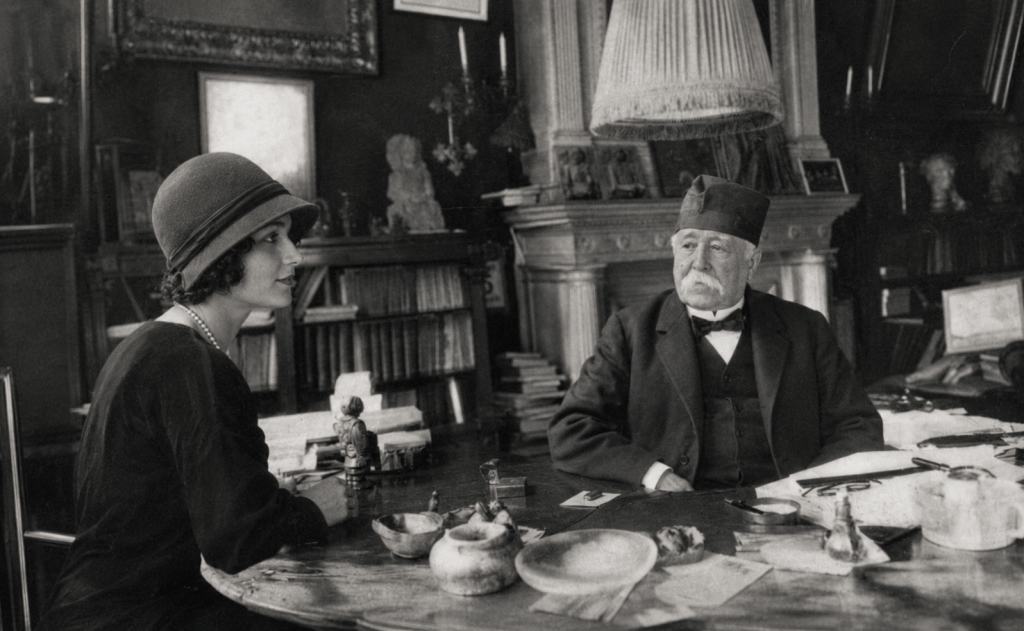
(Imaginary) photograph of the meeting between « The Tiger » and Pauline on August 15, 1926, at Clemenceau’s Parisian home on Rue Benjamin-Franklin (Clemenceau is passing through, between two extended stays at his house in Vendée).

The Historian’s Corner

1. 8, Rue Benjamin-Franklin: The Tiger’s Lair

Having stepped back from active politics following his defeat in the 1920 presidential election, Georges Clemenceau divided his time between his modest home in Saint-Vincent-sur-Jard (Vendée) and his Parisian apartment at 8, rue Benjamin-Franklin (in the 16th arrondissement, now a museum).

In this ground-floor flat opening onto a private garden, the “Père la Victoire” received close friends, former collaborators, and prominent international figures amidst thousands of books and his Asian art collection. Despite being 84 years old in 1926, he maintained a relentless work schedule, wearing his iconic skullcap and silk fingerless gloves to protect his skin, which had been sensitized by eczema.

2. Clemenceau the Physician: A Scientific Youth

Before becoming a journalist and statesman, Clemenceau was first a medical doctor. He defended his doctoral thesis in Paris in May 1865 (De la génération des éléments anatomiques / On the Generation of Anatomical Elements), deeply influenced by the positivism and scientific materialism of Auguste Comte and Charles Robin.

Although he practiced only briefly in the Montmartre district, he retained a lifelong fondness for medical practitioners and an enduring fascination with the natural and medical sciences.

3. The Formative Exile in the United States (1865–1869)

Freshly graduated and seeking to escape the authoritarian regime of Napoleon III, the 24-year-old Clemenceau sailed for the United States. He spent nearly four decisive years there:

  • Journalist: He served as a regular correspondent for the Parisian newspaper Le Temps, covering post-Civil War Reconstruction and offering incisive analyses of nascent American democratic institutions.
  • Teacher: He taught French and horseback riding at the Catharine Aiken School, a young women’s academy in Stamford, Connecticut.
  • Personal Life: There he met one of his students, Mary Plummer, whom he married in 1869 before returning to France.

This immersive stay allowed him to achieve fluent English and cultivate an extensive network of transatlantic friendships that lasted throughout his lifetime.

4. Why Eleanor Roosevelt in 1926?

Choosing to address a letter of recommendation to Eleanor Roosevelt rather than her husband Franklin was especially shrewd in 1926:

  • FDR’s relative withdrawal: After contracting polio in 1921, Franklin D. Roosevelt spent much of 1926 undergoing rehabilitation in Warm Springs, Georgia. He had not yet been elected Governor of New York (an office he would assume in 1928).
  • A woman of influence in Manhattan: During this period, Eleanor Roosevelt became the true political and civic driving force of the family in New York. A tireless activist, she was deeply involved with the Women’s Trade Union League (WTUL) and the League of Women Voters, and was preparing to buy a stake in the Todhunter School for girls, where she also taught.
  • A supportive female network: Passionately committed to women’s intellectual and professional emancipation, Eleanor Roosevelt was the ideal ally to help guide a young Frenchwoman navigating the American metropolis.

5. The Clemenceau–Roosevelt Connection

Clemenceau shared a mutual admiration with the Roosevelt family, particularly with former Republican President Theodore Roosevelt (Eleanor’s uncle), whom he had met during his travels and with whom he shared a pugnacious temperament and legendary outspokenness.

During his final, triumphant speaking tour across the United States in late 1922, Clemenceau had rekindled his political and social contacts along the East Coast—making his intercession with the Roosevelt circle both entirely natural and highly effective.

Propulsé par WordPress.com.

Retour en haut ↑