
The July sun is already baking the Parisian cobblestones, but the national highway unfolding before us promises the crisp air of Normandy. I floor the Delage’s throttle. The four-cylinder engine revs up in a metallic roar that, to my immense delight, finally drowns out the thunderous voice of my passenger.
To my right, bundled up in his overcoat despite the heat, sits the true « Tiger. » Georges Clemenceau. My former boss. The man whose orders dictated the rhythm of my days and nights for years. But today, on this road to Giverny, the roles are reversed. Behind this large wooden steering wheel, I am the sole master on board. What unspeakable pleasure it is to pilot this machine and escape, if only for a few hours, the uninterrupted stream of his directives! The rushing wind whips under the windshield, sweeping away the worries of the ministry and offering me a sense of absolute freedom.
The old man has to shout to make himself heard over the din of the engine and the whistling air. He fidgets, checking his pocket watch: he wants to be in Giverny at ten o’clock sharp. He bellows in my ear what he wrote to Monet ten days ago. He laughs in anticipation, a mischievous glint in his eye behind bushy eyebrows: while poor Monet is reduced to sipping his old man’s milk soup, he, Clemenceau, fully intends to arrive with « an appetite to devour everything » and wolf down all the fish of the Loire and the cattle of the Normandy pastures!
Driving our Torpedo at nearly 80 km/h along these dirt roads is an experience of such rawness that future generations, nestled in rolling lounges, will find it hard to imagine. Here, nothing is muffled, nothing is automated. It is a constant physical wrestle with the elements:
The din and the wind: No side windows, no roof. We are suspended in the open air, our faces whipped by a continuous blast of wind that forces us to wear thick leather goggles to avoid being blinded.
The ordeal of dust: The roads are unpaved. Every time I pass a cart or a truck, an immense curtain of white dust engulfs us. My long, ecru linen duster coat is already grey with soot. We breathe the road, we live it, we eat it.
The gear-shifting gymnastics: Every deceleration is a challenge. Since the gearbox is unsynchronized, I must practice the delicate art of double-clutching. A press of the pedal to disengage, a tap of the throttle in neutral to match the gear speeds, a second press of the pedal to engage the gear… If I miss, the gears screech in a sinister metallic crunch that makes the old man beside me grit his teeth.
The physical exertion: The steering is incredibly heavy. Without any power assistance, wrestling the Delage through the sharp bends past Vernon requires a true athlete’s grip. As for the braking, purely mechanical and cable-operated, it demands that I stomp on the pedal with all my weight, anticipating obstacles hundreds of meters in advance.
Despite the jolts from the leaf springs that threaten to break our backs at every pothole, the exhilaration is absolute. We roar through villages in a mechanical thunder, scattering chickens and turning the heads of peasants. In less than an hour, we will be at Monet’s. Until then, I savor every second of this tête-à-tête with speed, proud to pilot the Tiger toward his old friend, to the glorious rhythm of modernity.
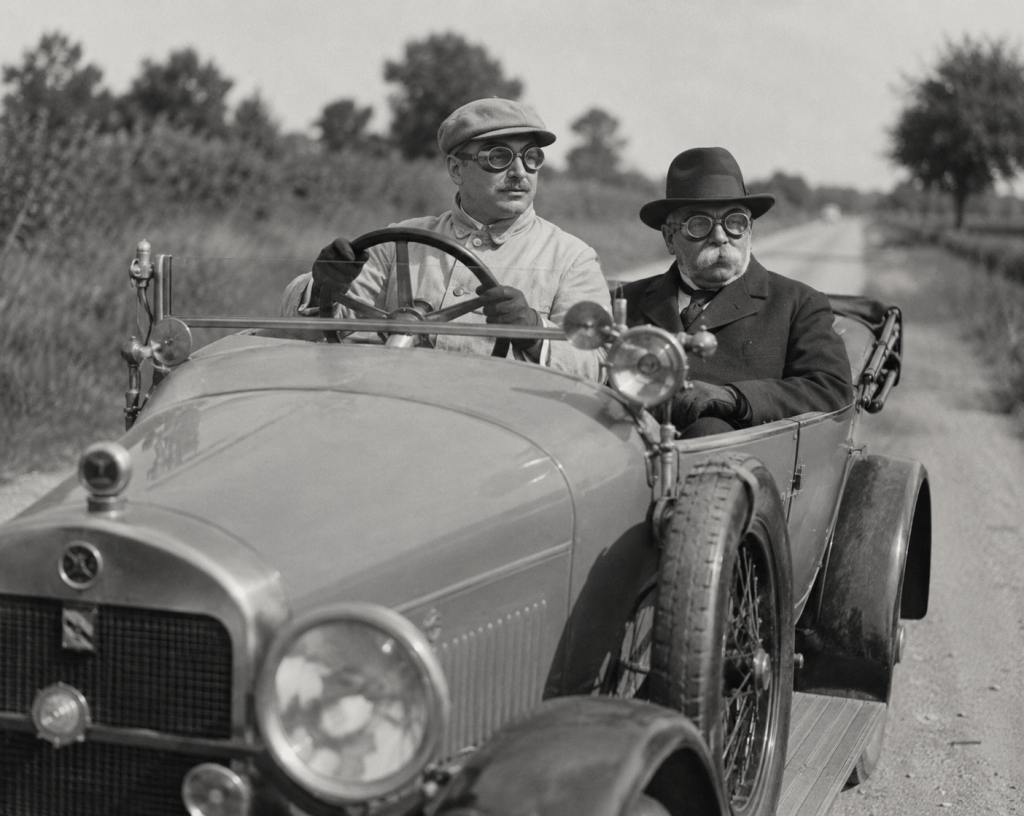
Olivier le Tigre drives Georges Clemenceau to Giverny to see the painter Claude Monet. (Images de fiction)
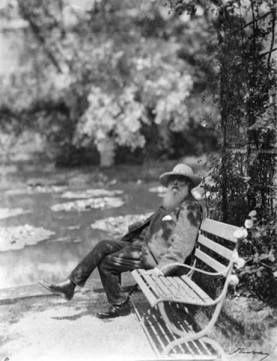
Claude Monet in the twilight of his life, in Giverny on July 12, 1926.
In a warm and humorous letter dated July 2, 1926, Clemenceau wrote to his friend to confirm his visit that day:
« My dear friend, it is settled: on Monday, July 12 at 10 a.m., I shall arrive at your home with a ravenous appetite. While you savor your milk soup, you will see me devour all the fish of the Loire and the cattle from your pastures… »


Votre commentaire